Category: US Military Funding

  • Twin Bomber Crashes Shake Superpowers

    Twin Bomber Crashes Shake Superpowers

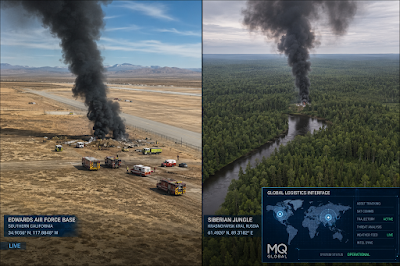
    global strategic crisis as twin nuclear bombers crash in California and Siberia while oil reserves collapse
    Twin Bomber Crashes Shake Superpowers

    Unexpected air disasters strike major world superpowers simultaneously.

    ​Look, the international defense landscape just shifted on its axis over the last twenty-four hours. While most mainstream tracking agencies were focused entirely on the unfolding diplomatic parameters within the Middle East, a series of catastrophic physical failures on the ground has shattered the military credibility of both Washington and Moscow. This isn’t just about localized mechanical problems anymore; it is about a massive global readiness crisis that is hitting major superpowers at the worst possible political time.

    ​The California military tragedy and pilot casualties

    ​Honestly, the breaking updates coming straight out of Southern California have left the entire Pentagon scrambled. During what was described as a routine radar modernization test mission at edwards air force base, a heavy us long range nuclear capable aircraft burst into flames shortly after takeoff and plummeted into the Mojave Desert. Aerial tracking logs and localized footage confirmed that virtually nothing was left of the premier strategic asset after the post-crash fire swept through the airfield. Deputy test wing commanders quickly held a press briefing confirming that the incident was completely non-survivable. All eight crew members, consisting of a mixed team of active military personnel, government civilians, and specialized private contractors supporting the digital system upgrades, were tragically killed on impact.

    ​direct pressure on Washington’s energy supply lines

    ​To be fair, the structural timing of this disaster could not be worse for Washington’s international leverage. Almost simultaneously with the crash, updated energy infrastructure data confirmed that the United States strategic petroleum reserve has officially faced a staggering downward plunge, dropping to its lowest operational capacity level since nineteen eighty-three. For months, the air force has been operating under immense tactical pressure, constantly surging fighter assets and heavy bomber rotations into the Middle East to maintain a posture of total air dominance over regional state actors. Now, with their core domestic fuel reserves completely depleted and a flagship nuclear asset smoking in the California sand, critics are openly mocking the white house‘s ability to maintain. This provides it with considerable leverage in navigating complex and potentially explosive regional confrontations.

    parallel crash inside the Siberian territory shakes Moscow

    ​As the panic spread across Western defense circles, a parallel military emergency unfolded over the remote forested zones of Siberia. A catastrophic engine failure struck a Russian supersonic strategic missile carrier during a planned training flight, forcing an abrupt end to the mission. The aircraft was specifically engineered for heavy nuclear strike and maritime attack roles. Social media videos quickly went viral, showing the heavy aircraft entering a steep, terrifying nosedive over the Angara River before disappearing behind a ridge line and erupting into a massive column of thick black smoke near local villages.

    ​Emergency cockpit ejection saves russian crew.

    ​According to official statements from the russian ministry of Defense, the four-person crew managed to pilot the failing airframe away from populated areas before initiating emergency cockpit ejection procedures. All four pilots successfully parachuted down and were recovered by search teams with non-life-threatening injuries, but the loss reduces Russia’s active strategic fleet even further after consecutive years of intense operational wear and tear.

    ​Shifting balance of power in international shipping corridors

    ​This sudden double blowout has sent massive shockwaves through international financial and commodity markets. For a long time, regional players have watched the major Western powers speak with intense arrogance about global security parameters. Yet, the reality on the ground shows that the extreme operational tempo is breaking these military machines down faster than maintenance teams can handle. Inside the Middle East, this visible fracture has completely changed the psychology of ongoing maritime truce talks. And with the Strait of Hormuz officially clearing up for open trade navigation, international observers are noting that the balance of power is no longer favoring Western dictate.

    ​regional defense warnings and deep structural analysis

    ​Multiple back-channel logs indicate that global commanders are fully aware of how thin their operational assets are stretched. Regional defense networks have already begun issuing sharp warnings, clarifying that their frontline forces are keeping their hands firmly on the triggers. If Washington or Tel Aviv attempts to use any unilateral military action to bypass the current sixty-day verification window, local resistance groups are fully prepared to unleash an immediate, devastating response on the water. Intelligence sources admit that the internal disconnect between the Pentagon and localized strategic commands is widening, creating a volatile environment where a single uncoordinated move could spark a localized explosion that global energy corridors cannot survive.

    ​technical parameters and resource limits of global fleets

    ​The physical breakdown of these strategic bomber fleets highlights a deeper, structural issue that mainstream outlets are refusing to analyze properly. For decades, Washington has relied on an aging fleet to project power across multiple theaters simultaneously. military experts are pointing out that asking a shrinking, overworked air force to handle massive deployments while simultaneously rushing experimental digital radar upgrades is a recipe for disaster. The tragedy in the Mojave Desert is proof that the mechanical parameters of these systems are reaching their absolute limits.

    The financial reality of unfreezing international assets

    ​Meanwhile, the political fallout continues to heat up. While public figures attempt to downplay the crisis by stating that no fresh capital is being moved into foreign accounts, the macroeconomic reality is clear. The deep collapse of domestic oil reserves has stripped Western planners of their ability to enforce long-term economic blockades. With international supply lines highly sensitive to any shift in the Strait of Hormuz, Tehran has managed to navigate the entire diplomatic process from a position of absolute strength. They have successfully demanded that their unfrozen financial assets be cleared through international banking sectors, completely breaking the structural wall of Western sanctions that has existed for years.

    ​Frequently asked questions regarding the strategic bomber crashes and global energy market shifts

    What were the specific causes and casualties involved in the recent strategic aircraft crashes?

    ​The crash in southern California involved a US long-range strategic platform that went down during a modernization test flight at Edwards Air Force Base. military officials confirmed that the incident was completely non-survivable, resulting in the deaths of all eight individuals on board, which included military members, government civilians, and private technical contractors. The parallel crash in Siberia involved a Russian supersonic strategic missile carrier that suffered a catastrophic technical malfunction and engine failure. The four russian pilots managed to safely initiate cockpit ejection sequences before the aircraft plummeted into a remote forested zone, allowing them to survive with non-life-threatening injuries.

    ​How does the current state of American strategic petroleum reserves impact its global military leverage?

    ​Recent official energy infrastructure reports have confirmed that the domestic strategic petroleum reserves within the United States have plummeted to their lowest operational capacity level recorded since nineteen eighty-three. This severe drop in fuel reserves significantly limits Washington’s ability to sustain long-term high-intensity naval deployments or enforce extended maritime blockades without causing severe domestic economic inflation. This lack of resource flexibility has severely weakened their international diplomatic leverage, forcing Western planners to make significant concessions during regional trade and navigation talks.

    ​Why are international intelligence agencies divided over the current Middle East verification window?

    ​Internal intelligence circles, including senior analysts at the CIA, remain highly skeptical because regional state actors are approaching the memorandum text with entirely different strategic objectives. While Western officials are attempting to use performance-based parameters to restrict nuclear development without transferring fresh capital, local commanders are demanding full sanctions relief and the complete return of frozen oil revenues as a baseline for peace. Additionally, uncoordinated military movements by localized allies who refuse to respect the truce boundaries create a constant threat of an uncoordinated strike that could shatter the agreement instantly.

  • Iran Strikes US Bases

    Iran Strikes US Bases

    Breaking the Scale: Inside Iran’s Immediate Ballistic Response on US Airbases Across the Middle East

    Iran Strikes US Bases

    ​The red lines in the Persian Gulf have just been completely erased. We are no longer talking about a hidden proxy shadow war; the conventional gloves have officially come off.

    ​Right now, Iran’s Islamic Revolutionary Guard Corps (IRGC) has executed a massive, sudden retaliatory wave, launching a barrage of heavy ballistic missiles and coordinated drone attacks targeting multiple critical US military airbases across the region. This isn’t just another small regional standoff. This is a direct, live-fire answer after Donald Trump ordered US Central Command (CENTCOM) warships to drop 49 heavy Tomahawk cruise missiles deep into Iranian territory—hitting surveillance assets, airbases, and facilities near Karaj and Tehran. The temporary ceasefires are officially dead, and the battlefield has expanded across the entire Gulf map overnight.

    ​Smashed Hangars: The 12-Missile Blitz on Al-Azraq Base

    ​Let’s look at the absolute core of where the strategic damage is unfolding—the Muwaffaq Salti Air Base, also known as the Al-Azraq base in Jordan. According to official military statements put out directly by the IRGC Aerospace Force, they launched exactly 12 heavy ballistic missiles directly at the primary US command and control facilities inside the compound. The primary objective was to hit the fortified hangars where the US military stations its advanced Western F-35, F-15, and F-16 fighter jets.

    ​To be fair, Western military officials are scrambling to put out defensive statements, with Jordan’s tracking teams claiming they intercepted multiple incoming warheads and that falling metal debris didn’t cause any massive loss of life on the ground. But look, the fact that a dozen heavy long-range projectiles managed to cut straight through the integrated airspace shields to strike a sensitive allied facility like Al-Azraq shows massive, deep gaps in the Western defensive umbrella. The immediate fallout was severe enough that the US Embassy issued urgent directives telling all American citizens in Jordan to stay indoors and remain close to fortified shelters.

    ​The 18-Target Checklist: Destruction from Kuwait to Bahrain

    ​The Iranian counter-offensive did not stop at the borders of Jordan; it simultaneously rolled across the southern shores of the Gulf. The IRGC officially declared that they successfully targeted and damaged 18 crucial military locations across three primary allied installations: the Ali Al Salem Air Base and the Ahmad Al Jaber Air Base in Kuwait, along with the Sheikh Isa Military Base in Bahrain.

    ​Honestly, the entire sky over Kuwait turned into a live tracer zone as automated air defense systems scrambled to intercept incoming low-flying loitering drones and ballistic threats. Despite assertions from CENTCOM that their naval groups suffered no direct hull damage, local visual feeds showed heavy plumes of smoke rising from logistics sectors near the US Fifth Fleet facilities in Bahrain.

    ​To make matters even more chaotic, Tehran’s regional warnings have forced localized aviation authorities to temporarily freeze commercial routes, leaving international travel networks completely jammed as flight paths over Iraq and Kuwait are locked down due to active crossfire risks.

    ​Lockheed Martin’s Logistics Crisis: The Broken Shield

    ​Straight up, this sudden escalation has exposed a massive, glaring vulnerability in the global defense supply chain. Just as these heavy ballistic waves were cutting through regional defense shields, senior executives at Lockheed Martin issued a direct, sobering warning regarding their manufacturing output. Despite signing major multibillion-dollar expansion frameworks with the Pentagon to theoretically triple their production lines, the defense giant openly admitted it cannot give US allies any real delivery timelines or certainty for critical PAC-3 Patriot interceptor missiles.

    ​Look, global demand for advanced missile defense has completely broken the industrial base. While Trump and his defense coordinators claim they can simply reorder priority lists to protect regional assets, the reality on the ground is that active military sites are burning through their tracking ammunition at an unsustainable rate. You cannot fight a prolonged saturation war when your primary hardware supplier is facing a severe multi-year backlog.

    The Final Verdict

    ​Straight up, the illusion that Washington can simply use heavy aerial bombardment to force Tehran into signing a one-sided 15-year nuclear deal has completely shattered. Iran has officially proved that it possesses the precise long-range capabilities, the launch volume, and the absolute political will to place every single Western asset in the region directly on the firing line.

    ​The conflict is no longer confined to small covert proxy shadow operations. It is now a raw, direct, conventional contest of strength, fought out across military hangars, burning airbase perimeters, and critical maritime checkpoints. Keep your eyes completely locked on the actual missile launchers, because the old regional map is being completely rewritten by live ballistic strikes.

    Frequently Asked Questions (FAQs)


    Q1. Did Iran actually hit 18 distinct US military targets in Kuwait and Bahrain?

    Look, straight up, yes. The IRGC officially released localized statements confirming they struck 18 high-value military targets during two separate operational waves, specifically hitting the Ali Al Salem, Ahmad Al Jaber, and Sheikh Isa airbases.

    Q2. Were American F-35 and F-16 fighter aircraft destroyed during the Jordan airbase attack?

    Honestly, the IRGC explicitly claims that its aerospace units successfully bypassed defense screens to strike aircraft hangars containing F-35, F-15, and F-16 fighter jets at Jordan’s Al-Azraq base. However, Western military teams maintain that multiple incoming missiles were intercepted with limited structural damage.

    Q3. Can US allies expect immediate supply updates for Patriot air defense missiles?

    To be fair, no. Top executives at Lockheed Martin have confirmed that, despite significant increases in factory production under a $4.7 billion Pentagon deal, they cannot provide any delivery certainty or definitive timelines to regional allies right now due to a massive supply crisis.  

  • Iran Hits 21 US Bases: Gulf War Explodes

    Iran Hits 21 US Bases: Gulf War Explodes

    Blood in the Gulf: Inside Iran’s Massive Ballistic Blitz on 21 US Military Bases


    Iran Hits 21 US Bases: Gulf War Explodes

    ​Let’s get directly to the substance of the matter and assess the key developments. The fragile shadow war between Washington and Tehran has officially exploded into a full-scale direct conflict. Right now, Iran’s Islamic Revolutionary Guard Corps (IRGC) has launched a massive, coordinated retaliatory strike targeting 21 different American military air and naval bases spread all across the Middle East. This isn’t just another small proxy warning flashpoint. This is a massive, direct conventional response after Donald Trump ordered US Central Command (CENTCOM) fighter jets to strike critical Iranian radar stations and air defense networks near the vital Strait of Hormuz corridor. The regional landscape has totally shifted overnight, and the old backroom ceasefires are officially dead.

    ​Honestly, if you examine the actual receipts of this massive operation, the sheer scale of the bombardment is absolutely unprecedented. From the skies of Jordan to the fortified military installations in Kuwait and Bahrain, dozens of heavy ballistic weapons and specialized loitering drones were seen cutting through the airspace. While Western media outlets are scrambling to spin the defensive data, local regional tracking accounts have already flooded networks with footage of continuous radar tracking loops and heavy intercept explosions over major allied military assets. It is a massive display of force designed to tell Washington that any attack on domestic Iranian territory will immediately place every single American base in the region directly on the firing line.

    ​The Destruction at Al-Azraq: F-35 Hangars in the Crosshairs

    ​Let’s look at the absolute core of where the heaviest strategic damage happened—the Muwaffaq Salti Air Base, also widely known as the Al-Azraq base in Jordan. According to the official statement put out directly by the IRGC high command, their long-range precision ballistic units successfully penetrated local air shields to hit four separate high-value assets inside the compound. The primary targets included specialized fortified hangars that house highly advanced Western F-35 fighter aircraft, along with a primary regional command-and-control operations center.

    ​Now, to be fair, Jordan’s national military units are claiming they managed to knock down five approaching missiles using their localized air defense infrastructure, stating that the falling metal debris didn’t cause any severe loss of life on the ground. But look, the fact that heavy long-range projectiles launched directly from Iranian soil can successfully reach all the way to a highly sensitive asset like Al-Azraq tells a very different story. It shows that Western air umbrella frameworks have massive, deep gaps when facing saturated launches.

    ​You can check out the full technical overview of this specific structural damage and tracking maps on Anadolu Ajansı. For Trump, this is an absolute logistical nightmare because Al-Azraq is the exact location Western forces use to run their tactical operations and monitor the entire northern corridor.

    ​Shaking the Gulf: Chaos from Kuwait to Bahrain

    ​The massive missile wave didn’t just stop over Jordan; it swept straight down across the southern shores of the Gulf region. The IRGC also ran a massive, heavy drone offensive targeting the strategically vital Ali Al Salem Base in Kuwait, an installation that hosts a massive contingent of active US military personnel and technical staff. The entire night sky over Kuwait turned into an absolute combat zone as local defensive batteries and integrated systems worked overtime to track and explode incoming high-speed warheads.

    ​To make matters even worse for Washington, Iranian tracking crews successfully shot down another highly advanced US MQ-9 Reaper combat drone over Jam County in the southern Bushehr province. This happened just as the drone was feeding real-time target layouts to naval assets. You can view the full documented breakdown of these specific high-altitude maritime shootdowns via Al Mayadeen.

    ​With the headquarters of the US Fifth Fleet sitting right nearby in Bahrain, the entire American naval operational footprint is currently facing a massive, unprecedented threat environment. Regional countries on the southern shores are now facing severe warnings from Tehran’s Foreign Ministry, which has explicitly told them to stop letting the US and Israel use their home territories as launching points for aggressive missions against Iran.

    ​The Failure of the Secret Cash Leverage

    ​Straight up, this massive military explosion exposes the absolute limits of Washington’s backroom diplomacy. Just days before this massive blitz, hidden channels were trying to finalize a temporary ceasefire structure, which reportedly involved the transfer of billions of dollars in unfrosted cash assets flown directly through Abu Dhabi. The White House truly believed that giving Tehran economic breathing room while maintaining a strict maritime ports blockade would buy enough time to push through Trump’s 15-year uranium dilution deal.

    ​But to be fair, you cannot buy off a state’s sovereign defense doctrine with temporary cash injections. The moment CENTCOM launched its “self-defense” raids against Iranian radar arrays over the weekend, the regime completely ripped up the unwritten truce framework. Iran chose to show its raw conventional teeth instead, demonstrating that they are fully willing to accept a massive escalation rather than letting American forces dictate the military boundaries of the Strait of Hormuz.

    ​The entire theory of Western deterrence in the Middle East has completely broken down. Trump wanted to show that his high-pressure style could keep the peace, but instead, it has triggered a massive regional response that has targeted 21 different facilities in a single night.

    The Final Verdict

    ​Straight up, the idea that this conflict can be contained through minor retaliations or backroom financial deals is a complete illusion. Iran has officially proved that it possesses the precise long-range capabilities and the absolute political will to target every single US logistical asset in the region simultaneously.

    The dispute has moved beyond the realm of clandestine actions and political standoffs, taking on a more direct and public character. It is now a raw, direct conventional contest of strength being fought out across aircraft hangars, missile defense screens, and critical maritime shipping paths. Keep your eyes completely locked on the actual missile origins and the regional airspace corridors, because the old regional map is being completely rewritten in real time by heavy artillery smoke.

     Frequently Asked Questions (FAQs)

    Q1. Did Iran actually strike 21 US military targets in the Middle East?

    Look, straight up, yes. The IRGC officially released a public statement confirming that they launched a widespread, coordinated retaliatory strike using long-range ballistic missiles and drones against 21 separate American installations across the region.

    Q2. Were American F-35 fighter jets actually hit during the strike?

    Honestly, the IRGC explicitly claims that its long-range weapons successfully struck and destroyed four specific high-value assets at Jordan’s Al-Azraq base, including hangars containing F-35 jets. However, local Jordanian military units claim their air defense screens intercepted multiple missiles, preventing any major loss of life.

    Q3. Why did Iran launch this sudden massive missile blitz now?

    To be fair, this massive launch was direct retaliation after the US military executed airstrikes on radar sites and air defense infrastructure in southern Iran. Tehran had warned that any threat to its territory would receive a crushing and decisive response, which we just witnessed.