Navigating the Economic Crossroads: A Deep Dive into Soft Landings and Recessions
Last Updated: September 2025
What’s New in This Update
- Incorporated the latest forecasts from the IMF’s July 2025 World Economic Outlook Update, World Bank’s January 2025 Global Economic Prospects, and OECD’s September 2025 Interim Report.
- Added fresh insights from J.P. Morgan’s mid-year 2025 market outlook and recent discussions on X (formerly Twitter) about recession risks.
- Updated regional breakdowns with new data on trade tensions, inflation trends, and policy uncertainties, including impacts from U.S. tariffs.
- Expanded analysis with a new table comparing GDP growth projections across major institutions and regions.
- Included emerging trends in AI-driven investments and emerging market resilience as potential growth boosters.
The global economy stands at a critical juncture, facing a stark divergence of potential futures. The outcome hinges on a fundamental question: will central banks be able to engineer a “soft landing,” a delicate slowdown that curbs inflation without triggering a deep recession? Or are we headed for a more severe economic contraction? This report provides a comprehensive analysis of these two competing scenarios, drawing on expert forecasts, key economic indicators, and the complex interplay of monetary policy and geopolitical risk. By dissecting the definitions, probabilities, and sectoral implications of each path, this analysis aims to equip decision-makers with a clear-eyed perspective on the economic landscape shaping up for 2025 and beyond.
Defining the Pathways: The Anatomy of a Soft Landing vs. a Recession
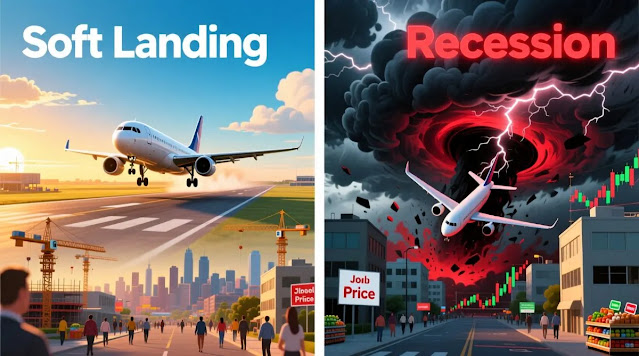
Understanding the future trajectory of the global economy requires a firm grasp of two distinct, yet often confused, economic concepts: the soft landing and the recession. These terms represent opposite ends of the economic cycle, each with unique characteristics, causes, and consequences. A recession is officially defined by the National Bureau of Economic Research (NBER) as a significant decline in economic activity that is spread across the economy and lasts more than a few months
.
This broad-based contraction is typically identified through a
composite of indicators, including declines in nonfarm employment, real
personal income, industrial production, and wholesale-retail sales.
While a common informal rule suggests a recession begins after two
consecutive quarters of negative GDP growth, the NBER’s assessment is
far more nuanced.
Historically, U.S. recessions have been characterized by a substantial
drop in real GDP—averaging 2.7% post-World War II—and a duration of over
a year. For example, the
2007-2009 financial crisis was a hard landing, resulting in a 10%
unemployment rate and the S&P 500 losing over half its value.
In contrast, a soft landing represents a highly desirable but exceedingly rare outcome. It is an economic scenario where the Federal Reserve successfully raises interest rates to combat inflation without pushing the economy into a full-blown recession
.
The primary goal is to slow the pace of economic activity enough to
bring inflation back down to a target level, such as the Fed’s 2% goal,
while maintaining stable employment. A successful soft landing is marked by positive GDP growth, low unemployment, and limited volatility in financial markets.
The term gained prominence during Alan Greenspan’s tenure in the 1990s
when the Fed managed to raise rates from 3% to 6% over 12 months without
causing a downturn.
However, achieving this precise balance is exceptionally difficult.
Former Fed Chair Ben Bernanke once compared monetary policy to driving a
car with an unreliable speedometer and a foggy windshield, highlighting
the inherent unpredictability and delayed effects of policy actions. As a result, economists estimate there has only been one confirmed soft landing since World War II,
making it a benchmark of central bank excellence rather than a routine
occurrence. The possibility of a “no-landing” scenario, where the
economy grows above its potential while inflation normalizes, is
considered so implausible by experts that they state it has never
occurred.
The distinction between these pathways extends to specific economic conditions and terminology. A “hard landing” is synonymous with a recession or a sharp slowdown that leads to job losses and declining consumer spending
.
Conversely, a “growth recession” describes a situation of very slow
growth, below 1% per quarter, which has been observed in the U.S. in
past periods like 1979 and 201.
Another related concept is a “mini-recession,” which can describe a
brief period of negative GDP growth that does not meet the broader
criteria for a formal recession. The U.S. experienced such a
mini-recession in the first two quarters of 2022 with negative GDP
growth, but strong Q3 growth helped fuel discussions of a potential soft
landing. Furthermore, a
“rolling recession” describes sector-specific downturns occurring even
amidst overall positive GDP growth; this has been evident in the U.S.
housing market, hit by high mortgage rates, and the manufacturing
sector, affected by shifting consumer demand toward services
. Understanding these subtle distinctions is crucial for interpreting economic data and assessing the true health of the economy.