Decoding the 62% Return: A Deep Dive into Workday’s (WDAY) Shareholder Value and Its Lessons for Indian Investors
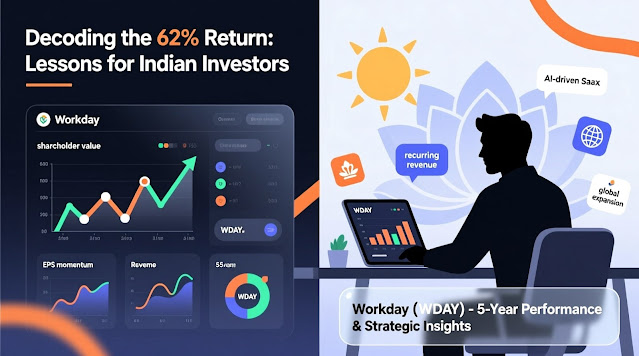
In an era of market volatility, identifying companies that can deliver consistent, substantial returns is a primary goal for any investor. The narrative surrounding Workday (NASDAQ: WDAY), a leading provider of enterprise cloud applications, offers a compelling case study in building shareholder value through innovation, strategic expansion, and disciplined execution. Over the past three years, from 2022 to 2025, Workday has generated a respectable shareholder return of approximately 62%, a figure that masks both significant challenges and extraordinary opportunities. This performance was achieved despite navigating steep market downturns, including a nearly 43% drop during the COVID-19 crash in 2020 and a 56% collapse in the 2022 inflation crisis. This report provides a comprehensive analysis of Workday’s financial trajectory, its strategic pivot towards Artificial Intelligence, and the broader market dynamics influencing its future. More importantly, it translates these complex financial and corporate developments into actionable insights and relatable stories for a diverse audience, including young professionals and students in India, offering a blueprint for understanding long-term investment success in a rapidly evolving global economy.
The Financial Engine Behind Workday’s Three-Year Performance
The 62% shareholder return over three years is not merely a headline number; it is the culmination of a powerful financial engine driven by robust revenue growth, improving profitability, and strong cash generation. To understand this achievement, one must dissect the underlying financial statements and operational metrics that have powered the company forward. It operates in the Software – Application sector, providing an AI platform for Human Capital Management (HCM) and finance used by more than 11,000 organizations globally, including a staggering two-thirds of the Fortune 500.
The foundation of success lies in its ability to consistently grow its top line. From fiscal year 2022 to 2025, the company demonstrated impressive momentum. Revenue grew from $5.14 billion in FY 2022 to $8.45 billion in FY 2025, representing a compound annual growth rate (CAGR) of approximately 17.9%. Another data source confirms similar growth, showing revenue rising from $7.9 billion to $9.0 billion in the last twelve months alone, with an average annual growth rate of 16.5% over the three years. This growth is not just about scale but also about product adoption and upsell potential. In the most recent quarter, revenue grew 12.6% year-over-year to $2.35 billion, surpassing Wall Street expectations. This consistent outperformance reflects deep customer penetration and a highly sticky SaaS business model.