Tag: Digital India

  • Jio IPO 2026: India’s $170B Telecom Giant

     Jio IPO 2026: Reliance Starts Draft Prospectus for India’s Epic $170 Billion Telecom Giant – All the Buzz and What It Means for You
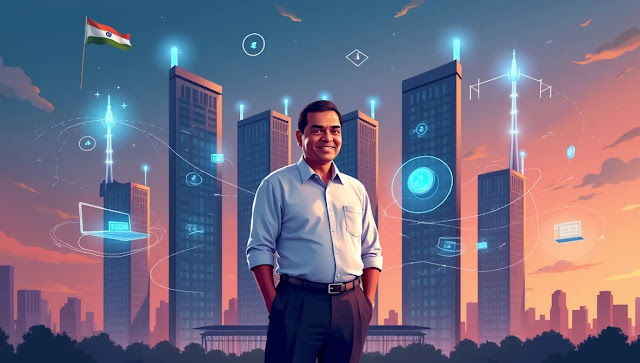
    Mukesh Ambani standing

    Key Takeaways

    • Record-Breaking Scale: The Jio IPO could raise up to $4.3 billion at a whopping $170 billion valuation, smashing India’s previous biggest IPO records and rivalling global tech giants.
    • Timeline Ahead: Reliance is informally chatting with banks now, with the draft prospectus filing eyed soon after new SEBI rules kick in – listing possibly in the first half of 2026.
    • Investor Opportunity: With over 450 million users and booming digital services, this IPO opens doors for everyday Indians to own a slice of Jio’s growth story.
    • Market Shaker: It could boost liquidity in Indian stocks, draw massive retail frenzy, and highlight Reliance’s shift from oil to tech dominance under Mukesh Ambani.
    • Smart Prep Needed: While exciting, watch for risks like telecom competition – here’s how to position yourself wisely.

    Imagine this: It’s 2016, and India is buzzing. A quiet revolution is brewing in the dusty streets of Mumbai and the bustling markets of Delhi. Suddenly, a new player crashes the party – Reliance Jio. Free data, dirt-cheap calls, and smartphones that feel like magic in your pocket. Overnight, millions who could barely afford a basic plan are streaming videos, chatting endlessly, and dreaming bigger. That was Mukesh Ambani’s masterstroke, turning Reliance from an oil behemoth into India’s digital heartbeat. Fast forward to December 2025, and the whispers are louder than ever. Reliance isn’t just talking growth anymore; they’re drafting the blueprint for what could be the mother of all IPOs. Yes, the Jio IPO is here – or at least, it’s revving up its engines.

    Picture Mukesh Ambani, the man who built an empire worth trillions, standing at the edge of something even bigger. Jio Platforms, its crown jewel in telecom and digital services, is gearing up for a public listing that could value it at a staggering $170 billion. That’s not pocket change; it’s bigger than most countries’ GDPs and could eclipse every IPO India has ever seen. Hyundai Motor India’s $3.3 billion debut last year? Cute, but Jio’s aiming to raise $4.3 billion with just a sliver of shares on offer. Why now? Why this scale? And most importantly, what does it mean for you – the everyday investor sipping chai and scrolling through stock apps?

    Let’s rewind a bit. Jio didn’t just enter the market; it flipped the board. Before 2016, telecom in India was a battlefield ruled by giants like Bharti Airtel and Vodafone Idea. Prices were sky-high, data was a luxury, and rural India was largely offline. Then Ambani drops the bomb: unlimited free voice calls and 4G data for peanuts. Within months, Jio snagged 100 million users – faster than Facebook or WhatsApp ever did. By 2025, that number has ballooned to over 450 million subscribers, powering everything from JioMart grocery deliveries to JioFiber home internet. It’s not just a phone company anymore; it’s a digital ecosystem weaving e-commerce, entertainment, and cloud services into one seamless web.

    But here’s the hook that keeps you reading: This IPO isn’t just about numbers on a balance sheet. It’s a story of ambition clashing with reality in one of the world’s fastest-growing economies. India, with its 1.4 billion people and a median age of 28, is a goldmine for tech. Yet, challenges lurk – fierce competition, regulatory hurdles from SEBI, and global whispers of economic slowdowns. Reliance knows this. That’s why they’re timing it perfectly, waiting for new IPO rules that let big players like Jio dilute just 2.5% of equity while raising billions. It’s clever, almost poetic – Ambani’s way of saying, “We’re not selling the farm; we’re just opening the gate.”

    As we dive deeper, think about the ripple effects. For retail investors, this could be your ticket to the big leagues. No more watching from the sidelines as foreign funds gobble up stakes. Jio’s IPO might reserve a hefty chunk for you – the mum in a small town buying her first mutual fund, or the engineer in Bangalore eyeing long-term wealth. But excitement aside, let’s get real. Valuations this high come with questions: Is $170 billion justified? Can Jio keep outpacing rivals like Airtel, now valued at $140 billion? And what if tariffs crash further or 5G rollout hits snags?

    (more…)

  • Can India Turn the AI Threat into Its Next IT Boom?

    outsourcing to AI innovation

    India’s AI Boom: Turning the Disruptor into Our Next $17B Goldmine


    ​Look, if you were hanging around the Bangalore tech parks back in the 90s, you literally saw a $245 billion empire being born from scratch. It was all about grit and late-night coding. But as we sit here on October 22, 2025, that same empire is facing a massive “adapt or die” moment. Honestly, it’s bigger than the Y2K bug ever was. Artificial Intelligence isn’t just knocking at the door; it has basically walked in and started rearranging the furniture. While some headlines are full of scary stories about call center jobs vanishing, there is a much bigger, more exciting story happening under the hood.

    ​This isn’t just about surviving the wave; it’s about leading it. From the IndiaAI Mission getting a huge ₹10,000 crore boost to our own models like BharatGen launching back in June 2025, India is shifting fast. We are moving from being the world’s “back office” to becoming its actual “AI engine.” Here is the raw truth about how we are flipping the script on the AI threat.

    ​The Reality Check: Why the Tech Parks are Nervous

    ​To be fair, the anxiety you see on LinkedIn or in the Noida BPO hubs is 100% real. When the International Labour Organisation (ILO) says that 70% of Indian jobs could be automated, people are going to listen. We’ve already seen hiring in the BPO sector drop by 72% this past year. Why? Because AI chatbots are becoming almost indistinguishable from humans.

    The “At-Risk” Zones right now:

    • BPO & Call Centres: About 1.65 million people are in the crosshairs. If a job is just about answering basic questions, an AI agent is now doing it for way less money.
    • Junior Developers: Tools like GitHub Copilot are doing 40% of the heavy lifting. The “entry-level” role is being redefined as we speak.
    • Routine Data Analysis: AI models can now process a year’s worth of spreadsheets in seconds. Data entry is basically a thing of the past.

    The Generative AI Opportunity: A New $17B Market

    ​Now, flip the script for a second. While routine jobs are vanishing, high-value opportunities are absolutely exploding. The Generative AI market in India is projected to reach $17 billion by 2027. We aren’t just “fixing bugs” for Western companies anymore; we are actually building the brains.

    Why India has the Edge:

    • The Talent Pool: We have 1.5 million AI-skilled professionals. That’s a massive army of brains ready to go.
    • Cost Advantage: Even in the AI era, Indian talent is more accessible, making us the top choice for global AI exports.
    • Homegrown Innovation: Startups like Sarvam AI are building models that understand Hindi slang and Indian culture better than any US chatbot ever could.

    The Pivot: How the “Big Boys” are Raking it In

    ​Straight up, the big giants like TCS, Infosys, and HCLTech aren’t panicking—they’re pivoting. They’ve realized that selling “hours of labor” is the old way. The new money is in selling “intelligence-as-a-service.”

    ​In Q2 2025, HCLTech saw its AI revenue hit $100 million. They are helping global banks integrate Agentic AI—these are bots that don’t just talk, they actually do stuff, like processing insurance claims or managing supply chains on their own. This shift is creating a huge demand for AI architects and ethics experts.

    ​The “John Deere” Lesson: AI Beyond the Cubicle

    ​We often forget that AI’s biggest impact in India won’t just be in a glass office—it’ll be in the fields and factories. Look at the John Deere example: by putting AI into tractors for precision farming, they boosted yields by 15% and saw their stock surge 200% by 2025.

    ​India is doing the exact same thing. Startups like CropIn and Fasal are using sensors and AI to help farmers in Maharashtra and Karnataka. They are predicting pest attacks and boosting local incomes by 30%. If we scale this up, NITI Aayog thinks we can add $500 billion to our GDP by 2030. This is how a “threat” becomes a “boom” for the most important sector of our country.

    ​Government Muscle: The IndiaAI Mission

    ​Properly speaking, the government has finally put its money where its mouth is. The IndiaAI Mission, launched with a $1.2 billion war chest, is the turbocharger our startups needed.

    1. BharatGen: Our first multimodal AI model, launched in June 2025, handles 22 Indian languages. It doesn’t just process English; it understands the soul of India.
    2. Bhashini: This platform is breaking the language barrier for 200 million people, letting them use AI for banking, education, and health.
    3. The Vizag Hub: Google’s $15 billion AI hub in Visakhapatnam is a total game-changer. It’s creating 50,000 new roles in edge computing.

    Challenges: The Roadblocks We Can’t Ignore

    ​To be fair, it’s not all smooth sailing. We have some serious hurdles to clear if we want to win this race:

    • The Digital Divide: Only 40% of rural India has stable internet. AI can’t help a farmer who can’t get a signal on his phone.
    • Power & Water: Data centers are thirsty, and they need a lot of power. We need sustainable infrastructure to keep these “AI brains” running.
    • Ethics & Bias: AI models can sometimes amplify social biases. We need a strong set of rules to ensure “AI for All” actually stays fair.

    Summary Table: The Winners of the AI Shift (Oct 2025)

    Sector/Company

          AI Focus Area

    Key 2025 Result

    Persistent Systems

        Agri & Health AI

                  30% yield boosts; stock up 150%.

    Infosys

         Automation 

         (Nia)

                  $2B in AI-related deals this year.

    BPO Sector

        AI Ethics & 

        Training

                  Moving agents to be AI

                       “Overseers.”

    Agriculture

       Crop Prediction

                 AI-driven sensors helping 

                10,000+ farmers.

    FAQs: The Burning Questions on AI in India

    Will AI kill all entry-level IT jobs?

    Honestly, no. But it will definitely kill the “boring” ones. If your job was just copy-pasting code or reading from a script, it’s gone. But if you can oversee an AI agent or design workflows, you’re more valuable than ever. We expect 20 million new roles in data science by 2027.

    Is India’s AI actually better than ChatGPT?

    For Indian contexts, yes. Models like BharatGen understand our languages and culture much better. While ChatGPT is a great generalist, Indian AI is becoming the “specialist” for our 1.4 billion people.

    Can a small business in India even afford AI?

    Actually, yes. With the government’s ₹10,000 crore grant system, even small startups are getting funds to build. Plus, tools like Bhashini are making AI accessible to someone running a local factory or a kirana store.

    ​Conclusion: Time to Surf the Wave

    ​In summary, India isn’t just at a crossroads; we are on a launchpad. The AI threat is real for those who refuse to learn, but for the rest of us, it is the next massive IT boom. We missed the boat on hardware decades ago, but we are steering the ship when it comes to AI services.

    ​The path to a $17 billion AI market by 2027 is paved with reskilling and bold policy. The world is watching to see if we can turn this disruptor into our greatest triumph.

    What’s your move? Are you upskilling for an AI role, or are you betting on the next big AI-driven startup? Drop a comment below—let’s talk tech!

    Note: This is for educational purposes only. Not financial advice. We are not SEBI-registered.