Why Earnings Misses Are Facing Unprecedented Punishment in 2025: A Deep Dive into Wall Street’s High Stakes
Introduction: A High-Stakes Earnings Season
The summer of 2025 has ushered in a critical earnings season, where publicly traded companies reveal their quarterly financial performance. This period is a window into how businesses are faring and often dictates stock price movements. However, this year’s earnings season is unfolding under unique circumstances: record-high stock valuations, heightened economic uncertainties, and a market with little patience for underperformance. As a result, companies missing earnings expectations are facing sharper stock price drops than usual, while even those beating estimates often see muted gains. This post explores why earnings misses are being punished so severely in 2025, what it means for investors, and how to navigate this volatile landscape, with insights tailored for Indian readers.
Visual Suggestion: Insert a bold infographic here summarizing key trends of the 2025 earnings season, such as the percentage of companies beating estimates and the average stock price reaction to misses.
The State of the Stock Market in 2025
The US stock market is riding a historic wave in 2025, with the S&P 500 gaining over 15% year-to-date and setting new record highs. The technology sector, led by giants like Apple, Microsoft, and Amazon, has been a key driver of this rally. However, this bull run comes with increased volatility, as evidenced by occasional spikes in the VIX index, a measure of market fear, often triggered by tariff announcements and other economic uncertainties.
Analysts project a modest 4.8% year-over-year earnings growth for S&P 500 companies in Q2 2025, the lowest since Q4 2023, according to FactSet. This tempered growth expectation sets a challenging stage, as investors are pricing stocks for near-perfect performance. The S&P 500’s average price-to-earnings (P/E) ratio, which compares a company’s stock price to its earnings, is currently above historical averages, signaling that stocks are trading at premium valuations. In such an environment, any sign of weakness can trigger significant sell-offs.
Visual Suggestion: Add a chart here showing the historical P/E ratio of the S&P 500 from 2018 to 2025 to illustrate current high valuations.
Why Earnings Misses Are Being Punished More Severely
When a company reports earnings below analysts’ expectations, its stock price typically declines. In 2025, however, these declines are more severe than usual. Several factors contribute to this trend:
-
High Valuations: Stocks are trading at elevated P/E ratios, meaning investors expect strong growth to justify current prices. Any earnings miss prompts a reassessment of a company’s future prospects, leading to sharp selloffs.
-
Elevated Expectations: Investors and analysts have set high bars, particularly for high-growth sectors like technology. FactSet reports that while 83% of S&P 500 companies beat earnings per share (EPS) estimates in Q2 2025, the average earnings surprise is 7.9%, below the 5-year average of 9.1%. This smaller-than-usual outperformance contributes to lackluster market reactions.
-
Economic Uncertainties: Trade policies, particularly tariffs, are creating uncertainty. Companies missing earnings may be seen as less equipped to handle these external pressures, amplifying investor reactions.
-
Investor Impatience: With abundant investment opportunities, investors are quick to shift capital from underperformers to outperformers, exacerbating stock price drops for companies that miss earnings.
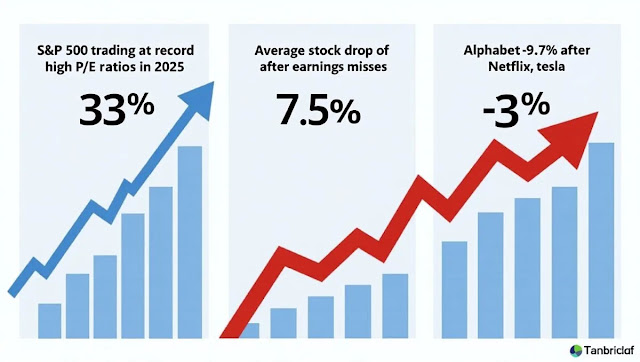
This trend echoes the 2022 earnings season, where companies missing both profit and sales expectations saw their stocks drop 6.7% more than the S&P 500 the next day, compared to a historical average gap of 2.4%. In 2025, the punishment appears even harsher, with some companies experiencing declines as high as 7.9% on average.
Visual Suggestion: Include a graph here comparing the average stock price reaction to earnings misses from 2018 to 2025, highlighting the severity of 2025 compared to 2022.
Case Studies: Companies Facing the Heat
To understand the market’s reaction, let’s examine a few examples from the 2025 earnings season:
-
Alphabet (GOOG): Alphabet, Google’s parent company, reported Q2 revenue of $69.1 billion, falling short of the expected $71 billion. Despite its strong position in the tech industry, its stock plummeted 9.1% the next day, performing 8.4 percentage points worse than the S&P 500’s 0.7% drop. This reflects the market’s zero-tolerance for misses in high-valuation stocks.
-
Netflix (NFLX): Netflix beat earnings estimates and raised its guidance, yet its stock fell 5%. Trading at approximately 40 times forward earnings, Netflix faces sky-high expectations, and any perceived shortfall triggers a sell-off.
-
Tesla (TSLA): Tesla reported earnings that exceeded estimates but saw its stock decline by 3% due to concerns about future growth amid rising competition and potential tariff impacts on its supply chain.
These cases highlight that in today’s market, meeting expectations is not enough; companies must significantly outperform to maintain investor confidence.
Visual Suggestion: Add a table summarizing the earnings results and stock price reactions for Alphabet, Netflix, and Tesla, with columns for reported revenue, expected revenue, EPS performance, and stock price change.
| Company |
Reported Revenue |
Expected Revenue |
EPS Performance |
Stock Price Change |
| Alphabet (GOOG) |
$69.1 billion |
$71 billion |
Below Forecast |
-9.1% |
| Netflix (NFLX) |
Above Estimates |
Above Estimates |
Beat Estimates |
-5% |
| Tesla (TSLA) |
Above Estimates |
Above Estimates |
Beat Estimates |
-3% |
The Role of Tariffs and Economic Uncertainties
Tariffs, which are taxes on imported goods, are a significant factor in the 2025 earnings season. President Trump’s tariff policies, including higher levies on autos, aluminum, and steel, have increased costs for companies reliant on global supply chains. For example, technology firms importing components from China face higher production costs, which can erode profit margins. Manufacturing sectors are also affected, as tariffs raise the cost of raw materials.
Analysts have lowered Q2 2025 earnings estimates for S&P 500 companies by 4.1%, a larger reduction than the 5-year average of 3.0% and the 10-year average of 3.1%. Much of this revision is attributed to tariff concerns, as companies struggle to predict the long-term impact of trade policies. The uncertainty surrounding tariff negotiations, with deadlines extended to August 1, 2025, keeps investors on edge, making them more reactive to earnings misses.
For Indian investors, this has direct implications. Many Indian mutual funds and portfolio management services invest in US tech stocks, which are vulnerable to these dynamics. Additionally, Indian IT companies like Tata Consultancy Services (TCS) and Infosys, which derive significant revenue from US clients, may face reduced spending if their clients cut budgets due to tariff-related cost pressures.
Visual Suggestion: Include an infographic here explaining how tariffs affect corporate profits, with examples from technology and manufacturing sectors.
Implications for Investors and the Economy
For investors, the 2025 earnings season highlights the need for careful analysis and risk management. High valuations mean that even minor disappointments can lead to significant stock price corrections. Investors should focus on companies with strong fundamentals and resilience against external pressures like tariffs.
From a broader economic perspective, the severe punishment of earnings misses could lead to more conservative corporate strategies. Companies may prioritize short-term gains over long-term investments to meet investor expectations, potentially stifling innovation and growth. This short-termism could have lasting implications for the economy, particularly if it dampens corporate investment in research and development.
For Indian investors, understanding these dynamics is crucial. For example, Ramesh, a teacher from a small village in India, invests in a mutual fund with exposure to US tech stocks. As the earnings season unfolds, Ramesh may see his portfolio’s value fluctuate due to the performance of these stocks. By staying informed and diversifying his investments, Ramesh can better manage these risks.
Conclusion: Navigating a Volatile Market
The 2025 earnings season is a high-stakes period for the stock market. With record-high valuations, economic uncertainties, and impatient investors, companies missing earnings are facing unprecedented punishment. This environment demands vigilance, strategic planning, and a long-term perspective from investors.
By staying informed, diversifying portfolios, and focusing on fundamentals, investors can navigate this volatile landscape and potentially capitalize on opportunities arising from market corrections. For Indian investors, understanding the global context and its impact on local investments is key to making informed decisions.
Visual Suggestion: Add an inspiring visual here, such as a motivational quote about resilience in investing, e.g., Indian investors can consider balanced funds that include both domestic and international exposure.
- Focus on Fundamentals: Look beyond quarterly results to assess a company’s long-term growth potential and resilience.
- Consult Professionals: If unsure, speak with a financial advisor to tailor your investment strategy to your goals and risk tolerance.
Interactive Element Suggestion: Embed a poll here asking readers which sector they think will be most affected by earnings misses (e.g., Technology, Manufacturing, Consumer Goods).