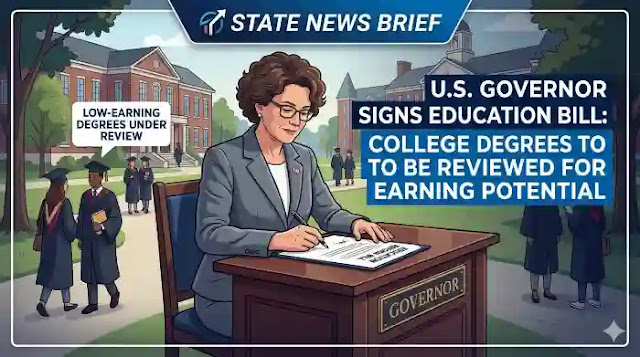
Indiana Targets Low-Earning College Degrees: What the New Bill Means for Students and Universities
Higher education in the United States is entering a new debate — one that many students, parents, and universities may find uncomfortable. Should taxpayer money support college programs that lead to low-paying careers?
That question is now at the center of a new policy in the state of Indiana. Recently, Mike Braun, the governor of Indiana, signed a bill that could dramatically reshape how universities think about certain degree programs. The legislation aims to identify and potentially eliminate college degrees that consistently lead to low earnings for graduates.
People in favour of this move believe it is a practical step to protect students from debt. On the other hand, those against it worry the policy could threaten the value of liberal arts education and reduce academic diversity on campuses.
Now, let’s explore what’s happening in more detail.
Why Indiana Is Targeting Low-Earning Degrees
For years, American students have been told that a college degree is the key to financial success. But reality has been more complicated. Student debt in the United States has grown to over $1.7 trillion, and many graduates find themselves working in jobs that do not pay enough to justify the cost of their education.
Some degree programs, according to labor data, consistently produce graduates with relatively low starting salaries. These often include certain fields within:
- humanities
- arts programs
- niche academic disciplines
- specialized social science tracks
Indiana lawmakers say the goal of the bill is not to eliminate these subjects entirely. Instead, the policy focuses on whether public funding should continue supporting programs that show weak economic outcomes for students. In other words, the state wants universities to pay closer attention to return on investment (ROI) for degrees.
How the New Law Works
The bill requires state education officials to review degree programs offered by public universities. Programs that consistently produce graduates with low earnings several years after graduation could face funding cuts or restructuring.
The idea is simple: if a program does not lead to strong career outcomes, universities may need to justify why it should continue receiving public support. This approach represents a shift in how governments evaluate higher education. Traditionally, universities were measured mainly by academic reputation and graduation rates. Now, policymakers are asking: Are students actually earning enough after graduation to justify the cost?
Comparing Degree Value and Career Focus
To understand the debate better, we can look at how different paths usually perform in the job market:
Degree Category Primary Focus Economic Outlook (ROI)
STEM Technology & Science High starting salaries
Healthcare Patient Care Strong job security
Liberal Arts Critical Thinking Slower initial growth
Trade Skills, Practical Labor, high demand, low debt
A Bigger Debate About College Value
The Indiana bill is part of a broader conversation happening across the United States. Many policymakers are questioning whether the traditional college system still aligns with modern job markets. Technology companies, healthcare systems, and engineering firms are often struggling to find workers with specialized technical skills.
Supporters of the Indiana policy say universities must adapt to economic realities. They argue that students should receive clearer signals about which degrees are likely to lead to stable careers.
Critics Warn About Risks to Education
Not everyone agrees. Some education experts argue that measuring a degree’s value purely through salary can be misleading. Many fields with lower starting pay — such as teaching or social work — still provide important contributions to society.
Critics worry that policies targeting low-earning degrees could unintentionally weaken programs that play essential cultural roles. Universities also emphasize that higher education is not only about immediate income; it helps students develop critical thinking and creativity.
Universities May Need to Adapt
Regardless of where people stand, one thing is clear: universities may need to rethink how they design degree programs. Some schools are already trying new strategies, such as:
The Financial Reality for Students
For many families, the issue comes down to a simple financial calculation. College tuition in the U.S. has risen dramatically over two decades. Students often graduate with significant debt, and their ability to repay it depends on their earning potential. This is why students are increasingly asking:
- What jobs can I get with this degree?
- What is the average salary after graduation?
- How much time is usually required to pay back student loans?
Could Other States Follow?
Indiana may not be the last state to do this. Several other states are already discussing policies that link university funding to student outcomes. If these policies spread, they could reshape the American education landscape. Universities might face stronger pressure to prove their programs lead to real career opportunities.
What This Means for Future Students
For students planning their path, the lesson is not to avoid certain fields, but to think carefully about how education connects to careers. Exploring growing industries and practical job opportunities is now more important than ever. The most successful graduates often combine passion with practical skills, like studying digital marketing alongside communications.
A Sign of Changing Priorities
Ultimately, Indiana’s new law reflects a shift in thinking. The belief that any college degree guarantees success is fading. Instead, people are looking closely at the relationship between education and long-term financial stability. As tuition costs rise, the question remains: Is a degree worth the investment?
Frequently Asked Questions (FAQs)
1. What is the Indiana low-earning degrees bill?
The Indiana low-earning degrees bill is a new law signed by Mike Braun that requires state officials to review college programs whose graduates consistently earn low salaries.
2. Why is Indiana targeting low-earning college degrees?
Indiana lawmakers want to improve the return on investment for students. With rising debt, the government wants universities to focus on programs that lead to stronger job prospects.
3. Which college degrees are considered low-earning degrees?
These are typically programs where graduates earn lower salaries several years after graduation, often including certain arts, humanities, or niche academic programs with limited job demand.
4. Will the Indiana education bill eliminate some college programs?
The bill does not automatically eliminate programs. It requires reviews, and universities may need to restructure or justify why those programs should keep receiving public money.
5. Could other U.S. states adopt similar education policies?
Yes. Several policymakers across the U.S. are discussing ways to link university funding to graduate outcomes.