Tag: Market Crash

  • Iran War: Global Market & Oil Crisis Update

    The Day the World’s Pocket Broke: Day 45 of the Iran Crisis


    BLOCKADE SHOCKS GLOBAL MARKETS


    ​Truth be told, I woke up today feeling like the world had shifted on its axis. I looked at the news, then my banking app, and then back at the news. It’s messy. Properly messy. We are officially on Day 45 of this Iran war, and if you thought things couldn’t get any worse, America just decided to drop a massive bombshell: a full-scale naval blockade.

    ​Basically, the US has put a giant “No Entry” sign on the waters around Iran. And while politicians in suits are talking about “strategy,” the rest of us are watching the stock market turn into a bloodbath. It’s not just numbers on a screen anymore; it’s about how much we’re going to pay for a loaf of bread tomorrow.

    ​The Red Sea of Stocks: Tel Aviv to Wall Street

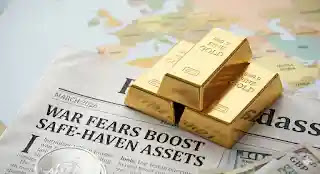
    ​The thing is, the markets are absolutely terrified. If you saw the charts today, the Tel Aviv Stock Exchange in Israel took a massive hit, dropping over 3%. Now, listen, in the world of finance, a 3% drop in a single day is like a physical punch to the gut. Investors are running for the hills. They aren’t looking for profits anymore; they are just trying to hide their cash in gold or anything that won’t vanish overnight.

    ​But it’s not just Israel. The panic has crossed the ocean. Wall Street is shaking because the US blockade has basically poked a hornet’s nest. Properly speaking, the stock market hates uncertainty. When the US blocks a major oil player like Iran, they aren’t just fighting a war; they are breaking the global supply chain. Every big company, from Apple to Tesla, is watching its shares dip because their shipping routes and energy costs are now a complete gamble.

    ​The Oil Rocket: Why Your Wallet is Screaming

    ​Listen, the most frightening part of this whole disaster is what’s happening at the petrol pump. Have you seen the gas price charts lately? The graph is pointing straight up like a rocket. It’s not a slow climb; it’s a vertical jump.

    ​Truth be told, oil is the blood of the world economy. When the US blocks Iran, they are cutting off a huge chunk of the world’s supply. Even if you don’t live anywhere near the Middle East, you’re going to feel this. Why? Because when the total amount of oil in the world drops, the price for what’s left goes crazy.

    ​This isn’t just about people with fancy sports cars. This is about the truck driver who delivers your groceries and the farmer who grows your vegetables. When their fuel costs double, your food prices double. It’s a chain reaction that nobody can escape. America has basically taken a match to the global economy and started a fire that’s burning through our savings.

    US military ship blocking

    ​The Big Question: What is America Doing?

    ​Now, this is the bit that really bothers me. Before this blockade, things were tense, but at least some ships were moving. Some countries were paying for passage, things were being traded, and there was a bit of stability. People’s pockets weren’t hurting this badly.

    ​But then, America stepped in and blocked everything. Truth be told, you have to ask yourself: what do they actually want? By cutting off those ships, they’ve chinked the last bit of hope for a stable market. They’ve taken away the little bit of relief that regular people had. It feels like they are making decisions in a room somewhere while the rest of us are left to figure out how to afford to drive to work. Honestly, it feels like they’ve stolen the peace of mind of the average person just to make a political point.

    ​The Mystery of the Endless War: Where is Israel’s Money?

    ​The thing is, this whole situation makes you wonder about the bigger picture. Israel has been fighting for three years now. Three long years of bombing Gaza, fighting in Lebanon, dealing with Yemen, and now this massive showdown with Iran.

    ​Listen, if any other country tried to fight a war on four fronts for three years, its economy would have collapsed months ago. War is expensive. Properly expensive. Every missile, every tank, every soldier costs a fortune. So, the question everyone is asking over coffee today is: where does all that money come from?

    ​To be fair, the answer is pretty obvious, but it’s hard to swallow. While the US is blocking oil and making life expensive for you and me, they are also sending billions of dollars in military aid to Israel. They’ve got unlimited support. America keeps the weapons flowing and the bank accounts full for the war, while the rest of the world struggles to pay for gas.

    ​It’s a strange world, isn’t it? One side gets endless money for barood (gunpowder), while the other side—the regular people—gets hit with a blockade that makes life unlivable.

    Europe: The Silent Victim

    ​We can’t talk about this without mentioning Europe. Unlike the US, which has a bit of its own oil, Europe is properly stuck. They depend on the Middle East for almost everything that keeps their lights on.

    ​Right now, the markets in London, Paris, and Berlin are looking just as bad as Tel Aviv. Factories are worried they won’t be able to afford to run their machines. The price of heating homes is going to go through the roof. To be fair, Europe is caught in the middle of a fight it didn’t start, but they are paying the highest price for it.

    What’s the Bottom Line?

    ​The truth is, Day 45 has changed everything. This isn’t just a “war update” anymore; it’s a global financial crisis. The US blockade has turned a regional fight into a worldwide struggle for survival.

    ​Listen, I don’t want to be the guy who only brings bad news, but we need to be realistic. As long as this blockade stays in place, oil prices will keep climbing. As long as the US keeps funding the war while blocking trade, the stock markets will stay in the red.

    ​Properly speaking, we are all connected. A decision made in Washington or a bomb dropped in the Middle East ripples out until it hits your local grocery store. It’s a chain reaction that started with politics but ended in our wallets.

    ​Truth be told, we are in for a rough ride. Keep your eyes on the oil prices—that’s the real pulse of the world right now. And maybe start thinking twice about that extra road trip. We need to look out for ourselves because, clearly, the people making these big decisions aren’t looking out for us.

    FAQ 


    Q1: Why are Tel Aviv stocks falling today?

    Ans: To be fair, the market is terrified. With the US blockade on Iran and the war hitting Day 45, investors are pulling their money out of Israel to stay safe.

    Q2: How does the US blockade of Iran affect me?

    Ans: Basically, it’s a chain reaction. The blockade cuts global oil supply, which makes gas prices rocket. This means everything from your food to your travel gets more expensive.

    Q3: Why is oil hitting record highs in April 2026?

    Ans: The thing is, when the US blocks a major player like Iran, the world’s oil supply drops. High demand and low supply always lead to a massive price surge.

    Q4: How is Israel still funding the war after 3 years?

    Ans: Listen, it’s a mix of massive military aid from the US and a strong internal reserve. While the world struggles with oil prices, the war machine keeps getting funded.

    Note: This is for educational purposes only. Not financial advice. We are not SEBI-registered.
  • 28 Days of War: How Iran-Israel Hit Global Markets

    Iran-Israel Hit Global Markets


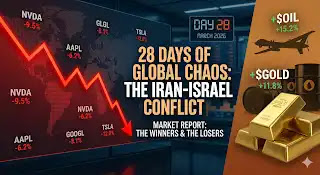
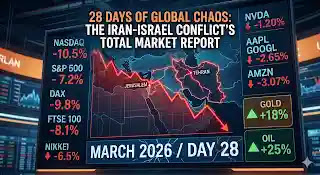
    28 Days of Global Market Chaos: The Full Report on the Iran-Israel Conflict

    ​Honestly, looking back at the last 28 days feels like we’ve lived through a whole year of financial history. When the news first broke about the US and Israel launching strikes on Iran, the world didn’t just stop to watch the news—it started moving its money. Fast.

    ​If you’ve been checking your portfolio, you know it’s been a proper mess. But to understand why your screen is covered in red, we need to look at the day-by-day breakdown. From Google’s advertising fears to Nvidia’s chip supply panic, here is the full, unfiltered story of how 28 days of war changed the world’s wealth.

    ​The First Week: The “Panic” Phase (Days 1–7)

    ​The madness started on Day 1 (late February/early March 2026). The moment the strikes were confirmed, the S&P 500 and the Nasdaq didn’t just dip—they fell off a cliff.

    ​Look, the first thing people do in a war is sell “Risk.” And nothing is seen as more “risky” than tech companies that rely on global trade.

    • Google (Alphabet Inc.): Straight up, Google took a hit of about 4.2% in the first three days. Why? Because when there is a war, companies stop spending money on ads. Google’s bread and butter is advertising. If Ford or Coca-Cola were worried about global supply chains, they would stop running expensive YouTube and Search ads.
    • Apple: On Day 3, Apple’s stock dropped by 3.8%. Investors were terrified that a wider war would mess up the shipping lanes in the Middle East, making it impossible to get parts for the next iPhone.
    • Europe’s Pain: In London, the FTSE 100 had its biggest one-day fall since the “Tariff Shock” of 2025, dropping 2.75% in a single afternoon.


    The Second Week: The Energy Crisis (Days 8–14)

    ​By Day 10, the war wasn’t just about missiles; it was about oil. Iran raised the possibility of shutting the Strait of Hormuz—basically the world’s petrol pipeline.

    ​This is where the “Winners” and “Losers” started to separate properly.

    Hit Global Markets

    ​The Winners: Big Oil and Defence

    ​To be fair, if you owned oil stocks, you were actually having a good time.

    • ExxonMobil and Chevron saw their stocks surge by about 6% to 8%.
    • Shell (UK): Shell’s stock was one of the few green spots in Europe, rising 5% as Brent Crude oil crossed $100 a barrel.
    • Lockheed Martin: The makers of the fighter jets used in the strikes saw their stock climb 9% in two weeks.

    The Losers: Airlines and Travel

    ​While oil companies were making bank, airlines were bleeding out.

    • Lufthansa (Germany): Their stock crashed by 15% because fuel became too expensive and people were too scared to fly near the conflict zone.
    • Booking.com and Airbnb saw a 10% slide in their stock prices over a week as travel demand weakened.

    The Third Week: The Nvidia Rollercoaster (Days 15–21)

    ​Now, let’s talk about Nvidia. Honestly, this was the most mental part of the month.

    ​At first, Nvidia stayed strong because everyone loves AI. But by Day 16, reality set in. NVIDIA doesn’t just make chips; it needs a stable world to sell them. When the US government started talking about shifting resources to the military, investors got scared that the AI boom might slow down.

    ​NVIDIA’s stock, which was near record highs, tumbled by 9.5% in a single week. It was a proper “Correction.” Even though Nvidia later announced a $1 Trillion revenue forecast, the war clouds were just too thick for people to stay invested.

    The Fourth Week: The “New Normal” (Days 22–28)

    ​That brings us to right now. Day 28. The initial “shock” has gone, but the damage is done.

    ​Today, the Nasdaq is officially in “Correction Territory,—which is a fancy way of saying it has fallen 10% from its recent peak.

    ​What happened to Google and Microsoft?

    • Google (Alphabet): As of Day 28, Google is down roughly 8% from where it started. The fear is that a long war will cause a global recession, and in a recession, nobody clicks on ads.
    • Microsoft: Microsoft has held up slightly better, only down 6%, because businesses still need their software (Office 365/Azure) even during a war. But their plans to build massive AI data centres in the Middle East have been put on ice, which has killed their momentum.

    Europe vs. America: Who got hit harder?

    ​To be fair, Europe has had a much worse time than America.

    Index

    28-Day Change

    Reason

    S&P 500 (US)

    -4.0%

    Tech sell-off but saved by Oil/Defence stocks.

    DAX (Germany)

    -9.6%

    Energy crisis and manufacturing slowdown.

    FTSE 100 (UK)

    -7.6%

    Banking and Insurance stocks took a beating.

    CAC 40 (France)

    -8.9%

    Luxury

    Straight up, the reason Europe is struggling is that it doesn’t have its own oil. When prices go up, German factories have to pay more, and their profits disappear. America, on the other hand, is the world’s biggest oil producer, so they have a “buffer.”

    The “Hidden” Losers: Luxury and Banking

    We always talk about Tech, but look at LVMH (Louis Vuitton) and Hermes in France. These are the crown jewels of European stocks. Over these 28 days, they’ve dropped by over 11%.
    Why? Because a lot of their customers are in the Middle East and Asia. When there is a war, the “Vibe” for luxury disappears. Nobody wants to buy a $10,000 bag when they are worried about missiles.
    And the Banks? They are caught in the middle. Banks like JP Morgan (US) and Barclays (UK) are worried that if the war goes on, people won’t be able to pay back their loans. Their stocks are down 5-8%.
    Gold hits an all-time high

    Day-by-Day Summary of the 28 Days


    Day 1-2: The “Black Opening.” Massive sell-off across all sectors.
    Day 5: Gold hits an all-time high of $5,300/oz. People are hiding their cash in “bricks of yellow.”
    Day 12: Oil hits $107 a barrel. The panic is at its peak.
    Day 18: The “False Hope.” Rumours of a ceasefire cause a 2% jump in Google and Apple, but it lasts only 24 hours.
    Day 25: Donald Trump makes a speech saying the war’s impact is “not as bad as expected,” but the market doesn’t believe him. The Dow fell 450 points in one day.
    Day 28 (Today): We are in a stalemate. The markets are flat, waiting for the next big move.

    The Bottom Line for Investors

    Honestly, the last 28 days have taught us a hard lesson: The world is connected. You might think Google is just a search engine, but it’s actually a global barometer for peace. When the world is at war, Google bleeds. When the world is at peace, Google grows.
    If you’re an investor, the best thing to do is stay calm. Look, markets have survived the Cold War, the Gulf War, and everything in between. They will survive this, too. But for now, the “Easy Money” era is over. We are in a period of “War Inflation,” and it’s going to take more than a few weeks to fix this.
    Stay safe, keep your eye on the charts, and maybe don’t check your portfolio every five minutes—it’s not good for your heart!

    Frequently Asked Questions (FAQs)


    1. Is this the right time to buy stocks like Apple or Google?
    Honestly, it depends on how long you can wait. Right now, big tech stocks are trading at a discount because of the war panic. If you are looking at the next five to ten years, this could be a great entry point. But look, don’t put all your money in at once—the next 28 days could still be a bit of a rocky ride.
    2. Why exactly did Google’s stock drop because of the Iran-Israel conflict?
    Straight up, it’s all about advertising. Google makes most of its money when companies pay to show ads on Search and YouTube. During a war, big brands like Ford or Coca-Cola often pause their ads to save money or because the “mood” isn’t right for selling cars. Less ad money means less profit for Google, which scares investors.
    3. Is Nvidia’s AI growth over because of this war?
    To be fair, probably not. NVIDIA forms the foundation of the AI world. While the stock dropped about 9% this month, it’s mostly because people are moving their cash into “safe” things like Gold. The demand for AI chips is still massive, so this is likely just a temporary breather rather than a total crash.
    4. Why are oil companies like Exxon and Shell actually making money?
    It’s a classic case of supply and demand. Close to 20% of the world’s oil supply travels through the Middle East. If the fighting gets worse, the taps might get turned off. This fear makes oil prices go up, and when oil is expensive, companies like ExxonMobil and Shell make billions in extra profit.
    5. Why did European markets fall more than the American ones?
    The main reason is energy. America produces a lot of its own oil and gas, so they have a “buffer.” Europe, however, has to import most of its energy. When the Middle East is in trouble, gas prices in Germany and the UK skyrocket, which hurts their factories and banks much harder than it hurts the US.
    6. Should I sell my Gold now that it has hit a record high?
    Look, Gold is the “Ultimate Insurance Policy.” Over these 28 days, it has been the best-performing asset because people trust it when things go south. Unless the war ends tomorrow, Gold will likely stay high. It’s usually better to keep a little bit of Gold in your pocket just in case things get even crazier.

    Note: This is for educational purposes only. Not financial advice. We are not SEBI-registered.
  • 2026 Global Market Crash: Lloyd Blankfein’s Warning

    The 2026 Global Market Crash: Decoding Lloyd Blankfein’s Dire Warning


    ​The financial world is currently on edge. When a man who navigated one of the greatest financial storms in history speaks up, the world stops to listen. Lloyd Blankfein, the former CEO of Goldman Sachs, has issued a chilling alert that he can “smell” a fresh market crisis brewing.

    ​But is this just another case of a veteran being overly cautious, or are we truly standing on the precipice of a 2026 global meltdown? In this deep dive, we explore why Blankfein’s “smell test” matters, the geopolitical triggers involved, and what you can do to safeguard your wealth.

    Who is Lloyd Blankfein and Why Should You Listen?

    ​To understand the weight of this warning, you have to look at the man behind it. Blankfein led Goldman Sachs from 2006 to 2018. This means he was the captain of the ship during the 2008 subprime mortgage crisis. He saw firsthand how systemic risks hide in plain sight before they explode.

    ​When Blankfein says the “horses are starting to whinny in the corral,” he is using a metaphor for the nervous energy that precedes a stampede. His experience with the 2008 crash, the 2020 COVID dip, and various energy shocks gives him a unique perspective. He isn’t looking at daily charts; he is looking at the structural integrity of the global economy.

    The “Perfect Storm” of 2026: What’s Triggering the Fear?

    ​A market crash is rarely caused by a single event. Usually, it is a “perfect storm” where multiple negative factors collide. According to recent reports and discussions, there are three primary pillars to this current fear:

    ​1. The Iran-US Geopolitical Powder Keg

    ​The most immediate threat is the escalating tension between Iran and the United States. Geopolitical instability is the enemy of the stock market. If a conflict breaks out, the first casualty is global trade. The Strait of Hormuz, a narrow waterway through which roughly 20% of the world’s oil flows, is at the center of this risk. Any blockade or military action here would send shockwaves through every stock exchange from New York to Mumbai.

    ​2. The 130% Energy Price Surge

    ​Energy is the lifeblood of the economy. Goldman Sachs has highlighted a terrifying possibility: if the Iran-US situation deteriorates, European gas prices could surge by as much as 130%.

    ​When energy prices skyrocket, the cost of production rises for every company. Logistics become expensive, air travel costs soar, and consumer spending power drops. This is called “Cost-Push Inflation,” and it is historically a precursor to severe market corrections.

    ​3. The IMF’s Red Flag

    ​It’s not just Blankfein raising the alarm. The International Monetary Fund (IMF) has already trimmed its global growth forecast for 2026. They expect the slowest pace of growth since the 2008 crisis (excluding the pandemic years). When growth stalls while debt remains at record highs, the “economic engine” begins to smoke.

    The Impact on India: Why We Aren’t Immune

    ​While the Indian economy has shown incredible resilience, we are not an island. A global crash triggered by US-Iran tensions would hit India through several channels:

    • FII Sell-off: Foreign Institutional Investors (FIIs) treat emerging markets as “risk-on” assets.
    • The Rupee and Oil: India imports about 85% of its crude oil, and high prices weaken the Rupee while spiking domestic inflation.
    • Sector Vulnerability: Sectors like Aviation, Paints, and Logistics—which are heavily dependent on oil derivatives—would see their profit margins vanish overnight.

    How to Prepare: The Investor’s Survival Guide

    ​A warning is not a reason to panic; it’s a reason to prepare. Here is how seasoned investors handle a “Blankfein-style” warning:

    1. Increase Your Gold Allocation: Gold has historically been the ultimate hedge against geopolitical chaos and market crashes.
    2. Maintain a Cash Buffer: Keeping 10-20% of your portfolio in cash allows you to buy high-quality stocks at a massive discount if a crash happens.
    3. Move to Defensive Sectors: Reduce exposure to oil-sensitive stocks and move toward FMCG, Pharmaceuticals, and Utilities.
    4. Avoid Panic Selling: History shows that markets always recover. Have a plan, set your stop losses, and don’t let emotions drive your decisions.

    ​Frequently Asked Questions (FAQs): Did Lloyd Blankfein warn about?

    Blankfein stated that he can “smell” a fresh financial crisis brewing, citing high debt, geopolitical tensions, and energy price risks as major concerns for 2026.

    Q2. How does the Iran-US conflict affect my stock portfolio?

    A conflict can lead to a blockade of the Strait of Hormuz, causing oil and gas prices to spike. This increases inflation and reduces corporate profits.

    Q3. Is the Indian stock market going to crash in 2026?

    While no one can predict the future, India remains vulnerable to global “liquidity shocks” if foreign investors pull out money during a global crisis.

    Q4. Why is the 130% gas price hike mentioned?

    Goldman Sachs analysts have warned that a major disruption in energy supply chains could lead to a 130% increase in European gas prices.

    Q5. Did the IMF confirm this economic slowdown?

    Yes, the IMF has lowered its 2026 global growth forecast to its slowest pace since the 2008 financial crisis.


    Conclusion: Stay Calm, Stay Prepared
    Lloyd Blankfein’s warning shouldn’t keep you up at night, but it should prompt you to look at your portfolio with a critical eye. The “smell” of a crash is often the smell of overvalued stocks meeting harsh reality. By diversifying into gold, keeping a cash reserve, and staying informed, you can turn a potential crisis into a long-term opportunity.
    Note: This is for educational purposes only. Not financial advice. We are not SEBI-registered.