Revealed: When Will ₹1 Lakh Grow to ₹1 Crore in PPF? Proven Strategies for Maximum Returns in 2025
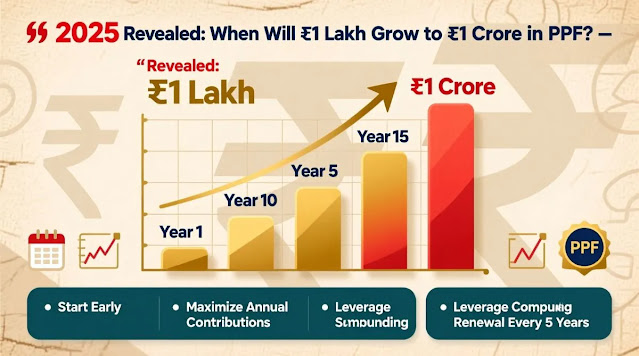
Key Takeaways
- Research suggests that with the current PPF interest rate of 7.1%, a single lump sum investment of ₹1 lakh could take around 67 years to reach ₹1 crore, highlighting the importance of time in compounding.
- It seems likely that regular annual contributions of ₹1 lakh can grow to ₹1 crore in about 31 years, though this depends on consistent deposits and rate stability.
- The evidence leans toward maximum annual contributions of ₹1.5 lakh, shortening the timeline to approximately 26 years, making it a faster path for wealth building.
- PPF offers tax-free, risk-free growth, but it’s essential to consider potential rate changes and compare with other options like fixed deposits for a balanced view.
Introduction: Understanding the Role of Compounding in PPF Growth
Imagine planting a small seed and watching it grow into a massive tree over the years. That’s the magic of compounding in the Public Provident Fund (PPF). PPF is a popular savings scheme in India, backed by the government, that helps people build wealth safely. It’s especially appealing for those who prefer low-risk investments. In this guide, we’ll explore how an initial investment of ₹1 lakh can turn into ₹1 crore through PPF, using accurate calculations based on the current interest rate. We’ll also share real-world examples and tips to help you make the most of it.
This analysis dives deep into PPF’s workings, with step-by-step math, comparisons, and strategies. Whether you’re a salaried worker or an entrepreneur, understanding this can help secure your financial future.
Overview of PPF: Key Features and Benefits
PPF has been a trusted option for Indians since 1968. It’s designed to encourage long-term savings with attractive benefits.
Features of PPF
- Variable Interest Rate: The government updates the rate quarterly. As of September 2025, it’s set at 7.1% per annum. This rate is compounded annually, meaning your money grows on the interest, too.
- Lock-in Period: You must keep the money in for 15 years, but you can extend it in blocks of 5 years for continued growth.
- Tax-Free Benefits: Under Section 80C of the Income Tax Act, your investments up to ₹1.5 lakh a year are deductible, and both interest and withdrawals are tax-free.
- Investment Range: You can start with as little as ₹500 a year, up to a maximum of ₹1.5 lakh. This makes it accessible for everyone.
Why PPF Remains Popular
PPF stands out because it’s risk-free – the government guarantees it, so there’s no chance of losing your principal. The tax efficiency is a big plus; you don’t pay tax on what you earn, which boosts your effective returns. Unlike stock market investments that can go up and down, PPF gives steady, predictable growth. For many, it’s a core part of retirement planning or saving for big goals like a child’s education.
The Science of Compounding in PPF
Compounding is like a snowball rolling down a hill – it starts small but gets bigger faster over time. In PPF, interest is added to your balance each year, and the next year’s interest is calculated on the new, larger amount.
Formula for Compound Interest
The basic formula for a lump sum is:
A = P (1 + r)^t
Where:
- A is the final amount
- P is the principal (₹1 lakh)
- R is the annual interest rate (0.071). It is the time in years
For regular contributions, it’s the future value of an annuity:
FV = PMT × [((1 + r)^t – 1) / r]
Where PMT is the annual payment.
These formulas show how time (t) is key – the longer you invest, the more compounding works in your favour.
Scenarios for Achieving ₹1 Crore
Let’s break down how long it takes under different investment approaches, using the current 7.1% rate. These are based on standard calculations from reliable sources.
Single Lump Sum Investment of ₹1 Lakh
If you invest ₹1 lakh once and let it grow without adding more, it would take approximately 67 years to reach ₹1 crore. This calculation assumes annual compounding at 7.1%. While PPF has a 15-year initial lock-in, you can extend it multiple times to achieve this long-term growth. However, this scenario underscores the need for patience and highlights why additional contributions are often better.
Regular Annual Contributions of ₹1 Lakh
Adding ₹1 lakh every year speeds things up significantly. Here’s a breakdown:
- After 15 years: Your corpus could grow to around ₹25.3 lakh.
- After 30 years, it has reached nearly ₹96.2 lakh.
- After 31 years: It crosses ₹1 crore, around ₹1.04 crore.
This shows how consistent deposits harness compounding more effectively.
To illustrate, here’s a table of year-by-year growth for ₹1 lakh annual contributions (using the ordinary annuity formula for conservative estimates):
| Year | Balance (₹) |
|---|---|
| 1 | 1,00,000 |
| 2 | 2,07,100 |
| 3 | 3,21,804 |
| 4 | 4,44,652 |
| 5 | 5,76,222 |
| 6 | 7,17,134 |
| 7 | 8,68,051 |
| 8 | 10,29,682 |
| 9 | 12,02,790 |
| 10 | 13,88,190 |
| 11 | 15,86,750 |
| 12 | 17,99,410 |
| 13 | 20,27,170 |
| 14 | 22,71,100 |
| 15 | 25,32,340 |
| 16 | 28,12,140 |
| 17 | 31,11,800 |
| 18 | 34,32,740 |
| 19 | 37,76,460 |
| 20 | 41,44,590 |
| 21 | 45,38,860 |
| 22 | 49,61,120 |
| 23 | 54,13,360 |
| 24 | 58,97,710 |
| 25 | 64,16,440 |
| 26 | 69,72,010 |
| 27 | 75,67,020 |
| 28 | 82,04,280 |
| 29 | 88,86,790 |
| 30 | 96,17,750 |
| 31 | 1,04,00,600 |
| 32 | 1,12,39,100 |
| 33 | 1,21,37,000 |
| 34 | 1,30,98,800 |
| 35 | 1,41,28,800 |
As you can see, it hits ₹1 crore between years 30 and 31.
Maximum Contributions of ₹1.5 Lakh Annually
To accelerate growth, contribute the maximum ₹1.5 lakh per year. This could reach ₹1 crore in about 26 years. For example:
- After 15 years: Around ₹38 lakh (based on calculators like Groww).
- After 25 years: Over ₹96 lakh.
- After 26 years: Crosses ₹1 crore.
This strategy maximises tax deductions and compounding, ideal for higher earners.