The Absolute Chaos Behind the Sudden Global Energy Blockade
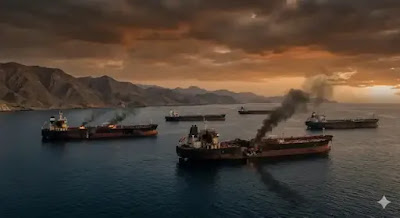
Look, if you have spent even five minutes glancing at the news or tracking the markets recently, you know that the global economy has just been hit by an absolute sledgehammer. We aren’t just dealing with typical political arguments in a faraway land anymore; we are living through a massive, real-time breakdown of the world’s primary energy highway.
Following the heavy military strikes on Iran on 28 February 2026, the single most critical sea corridor on the planet—the Strait of Hormuz—has effectively been choked shut.
And straight up, the speed of the fallout has been terrifying.
Within mere days of the maritime route freezing over, the price of international Brent Crude oil went on an absolute tear, skyrocketing from a comfortable $72 all the way up to a brutal $118 per barrel. Merchant shipping freight rates have instantly quadrupled, making it a complete “Red Zone” for anyone holding a stock portfolio. Let’s look past the generic media spin and pick apart the actual financial forces driving this crisis, completely throwing out the standard corporate marketing chatter.
The Tanker Crisis: A Timeline of the Escalation
To understand why the entire maritime industry has completely locked up, you have to look at the sheer violence that unfolded across the Gulf over the first week of March. It wasn’t a slow deterioration; it was an instantaneous explosion of risk that left commercial fleets completely defenseless.
The First Wave: 1 March
The chaos kicked off with two devastating attacks on a single afternoon. First, a Palau-flagged vessel named the Skylight was hit directly by a missile just north of Khasab, Oman, leaving four of its 15 Indian crew members severely injured and the ship structurally compromised.
A few hours later, a Marshall Islands-flagged tanker called the MKD VYOM was targeted by a remote drone boat. The resulting explosion inside the engine room tragically took the life of an Indian sailor, signaling to the world that commercial flags were now primary targets.
The Stagnation: 2 March
The violence didn’t stop there. The very next morning, two more massive tankers—the Stena Imperative and the Athena Nova—were struck by incoming projectiles. The reaction from global shipping lines was instant. Within hours of those strikes, commercial traffic attempting to navigate through the narrow passage collapsed by a staggering 90%.
The Financial Breaking Point: 5 March
The absolute final nail in the coffin happened when the big institutional underwriting syndicates officially cancelled all “War Risk” insurance coverage for the region. In the cut-throat world of global shipping, if a vessel cannot secure insurance, it simply cannot leave port. A ship owner isn’t going to risk a $200 million asset on a gamble, so the entire trade route effectively became a no-go zone.
By the Numbers: The Massive Cost Spikes
To see the true scale of the economic shock wave rippling through the markets, you only have to look at the staggering shifts in baseline maritime costs over the first ten days of March. Before the military strikes took place, daily tanker traffic through the Strait was moving along at a steady pace of over 20 large vessels a day. Right now, that number has slowed to a painful crawl of fewer than three ships daily.
The underlying insurance premiums for any captain brave enough to attempt the journey have ballooned from a baseline of $625,000 to an eye-watering $7.5 million per voyage. That is a mind-boggling 1000% spike in pure operational overhead in less than two weeks. The cost of sea transport is spiraling out of control as insurers tighten the screws and freight prices jump threefold.
Why Everyday Expenses are About to Explode
While petrol prices grab the headlines, the greater danger of a Middle East blockade lies in how heavily the world depends on interconnected shipping routes. Once the supply chain is put together, this crisis is going to hit the price of literally everything you buy. The first major issue is the sheer physical distance ships now have to travel. With the main passage blocked, commercial fleets are forced to divert their journeys entirely around the bottom of Africa via the Cape of Good Hope. This massive detour adds an extra 12 days to standard transit timetables.
Think about the compounding expenses of that extra time at sea. You are burning through heaps of extra fuel, paying days of extra crew wages, and delaying the delivery of core manufacturing components. This extra friction will drive up the retail price of everything from consumer electronics to high-street clothing lines. Furthermore, having oil hover near $118 a barrel means that overall inflation is bound to start rearing its head again. Central banks will likely react by keeping interest rates pinned at painful highs for significantly longer, which is the absolute worst-case scenario for the broader stock market.
The Verdict: Where is the Smart Money Moving?
At the end of the day, this entire crisis represents a massive, self-inflicted economic disaster that the financial markets were completely unprepared for. We are already seeing large institutional funds panic and sprint away from risky equities, dumping their cash straight into traditional safe-haven assets like Gold to protect their capital.
The smartest move you can make right now is to stop hoping for a quick diplomatic fix and actively prepare your finances for a prolonged stretch of high prices. The absolute jugular vein of the global energy grid has been placed in a tight chokehold, and the economic pressure is going to be felt across every single high street worldwide.
What do you reckon about the whole situation? Are the global markets completely overreacting to the shipping blockade, or are we staring down the barrel of a major global recession? Drop a comment down below and let’s get a proper conversation going!
Frequently Asked Questions
Why are global insurance companies completely refusing to cover these ships?
Honestly, it comes down to a basic calculation of risk. Because multiple vessels like the Skylight and MKD VYOM have been hit by missiles and drones in less than a week, the probability of a total loss is simply too high for underwriters to handle. Without a valid war risk premium policy, a ship owner faces losing hundreds of millions of dollars in a single afternoon, so they prefer to keep their fleets completely stationary.
Is there an alternative overland pipeline route to bypass the blockade?
Look, while a few land-based pipelines are cutting across neighboring countries, they simply do not possess the capacity to handle even half of the volume that usually moves through the water. The vast majority of the world’s energy supply has to travel via supertanker, which is exactly why shutting down this specific maritime corridor causes such massive economic damage.
How long should investors expect this energy crisis to last?
To be perfectly fair, it depends entirely on high-level diplomacy and whether military tensions cool down. Until the active drone and missile threats are removed and the big insurance syndicates reinstate standard war risk coverage, the global economy is going to remain locked inside this inflationary danger zone.
What does the term “Brent Crude” actually mean for everyday prices?
Straight up, Brent Crude is simply the international benchmark price used to value oil across the globe. When that specific marker jumps up by 64% in a few days, it acts as an immediate warning trigger that the cost of domestic petrol, household electricity bills, and factory manufacturing is about to step up significantly.
This is for educational purposes only. We are not financial advisors. Results may vary based on your individual debt situation
Leave a Reply