US Infrastructure Strikes Iran: Gulf Chaos
Ground Analysis: US Infrastructure Strikes Iran and the Evolving Gulf Crisis
Fresh assessments from the Persian Gulf indicate that regional military strategy has undergone a significant transformation. Current engagements have expanded significantly beyond low-impact tactical outposts, focusing systematically on core civil infrastructure, public utility networks, and primary logistics hubs. Field documentation confirms extensive communication grid failures, domestic supply shortages, and directly acknowledged military fatalities at multiple forward positions. This current structural focus indicates a calculated attempt to break defensive depth, while immediate retaliatory strikes are causing severe localized distress and generating heavy friction across international consumer supply chains.
Comprehensive Infrastructure Disruption in Southern Iran
Field updates show that recent air campaigns have heavily impacted civilian communication and utility networks across the southern provinces. The operational footprint of the current aerial deployment shows a deliberate concentration on areas controlling internal domestic distribution networks.
Targeted strikes carried out early Friday morning hit the core logistical links running across the southern coast. Multiple air units executed precise passes over the main transport arteries of Hormozgan province, creating massive structural issues. Ground observation verified that these tactical movements completely broke critical vehicle corridors, stopping regular trade runs from coastal supply drops to inland distribution points.
- Telecom Outage: Local communication lines faced severe issues. Field intelligence confirmed that strategic strikes brought down 116 cellular and switching towers inside Hormozgan province. This action broke up mobile networks, standard phone connectivity, and broadband lines throughout major local districts like northern Bandar Abbas and Hajiaabad.
- Water Supply Damage: Public utility nodes have suffered direct damage. Heavy physical degradation occurred at a primary water pump control station and a high-capacity water desalination grid facility located on Qeshm Island. Because this facility serves as the singular clean water grid connection for 20 local villages, the sudden operational shutdown has severely impacted local populations. Official counts and field logs show that roughly 10,000 local citizens are currently coping with a complete loss of mainlined domestic water distribution.
- Academic Suspensions: Due to the severe damage to the regional travel ways, school operations had to be put on immediate hold. The regional education authority issued an urgent safety update canceling final graduation examinations for all senior students across the southern areas, which include Hormozgan, Bushehr, Khuzestan, and Sistan and Baluchestan. Local officials stated that testing centers will remain closed for the foreseeable future because the main highway access points are no longer safe for travel.
Smashed Bridges and Blocked Transit Corridors
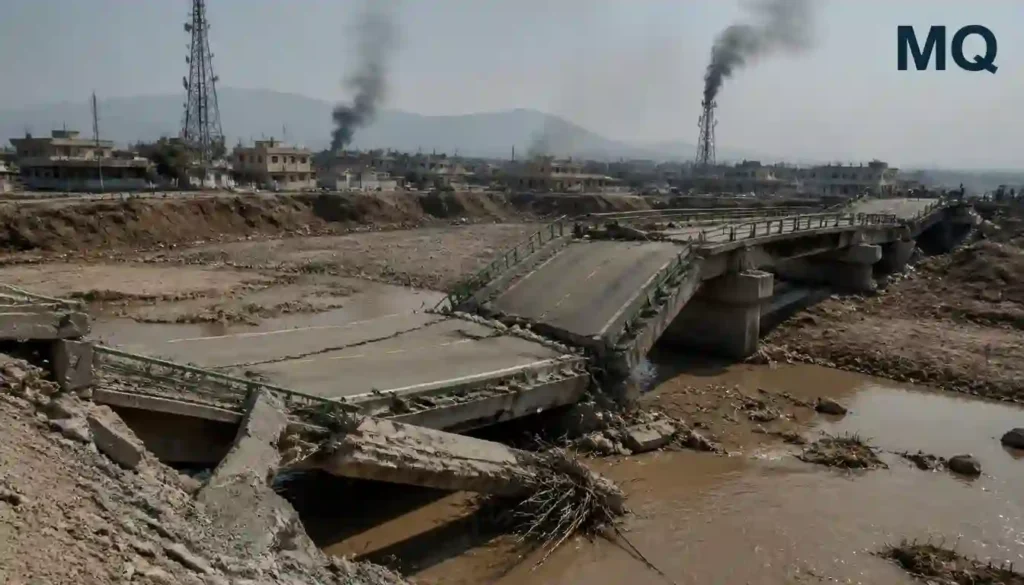
Available reports suggest that naval-launched Tomahawk strikes significantly disrupted key transport corridors, affecting both primary and secondary road networks. Initial assessments suggest the targeting strategy focused on severing transport links between the deep-water logistical hub at Bandar Abbas and the broader inland transit network. Engineers conducting field inspections reported extensive structural damage to two primary multi-lane bridges west of the city, with the main transport corridor leading towards the region also significantly impacted. Rudan is experiencing an absolute structural break.
The main bridge leading into Bandar Abbas sustained catastrophic structural failure. Local traffic logs show commercial trucks and transit vehicles attempting to bypass the wreckage using unpaved, muddy routes underneath the broken concrete sections, causing miles of logistics gridlock along the coast. Heavy freight trucks and commercial delivery vehicles are facing massive delays, stuck for hours in unmanaged detours because the original paved surface has been completely removed by precision explosions.
Strategic tunnels built through mountain passes to connect isolated rural zones have similarly faced heavy precision strikes, leaving local engineering crews working to clear major rockfalls. Total casualty assessments from the regional health authorities indicate that ongoing strikes since late June have led to over 50 fatalities and more than 500 documented injuries, including civilian deaths recorded during the highway bombardments. Field medical centers operating out of Hormozgan confirmed that these unexpected night strikes resulted in multiple civil casualties, including the verified deaths of two young girls caught in the immediate fragmentation radius on the main highway.
Retaliatory Missile Strikes and Confirmed Personnel Losses
In response to the domestic infrastructure damage, the IRGC executed swift cross-border operations utilizing precision tactical systems. The defensive perimeters of major installations recorded multiple incoming profiles as long-range rocket units and complex loitering arrays entered neighboring airspace, forcing security assets to take immediate evasive measures.
Official CENTCOM Fatality Confirmation
In an official release, CENTCOM provided details of the combat losses reported following the overnight raids on forward operating facilities. Recent military updates suggest that cross-border strikes have inflicted personnel losses in forward operating areas. The latest official update states: “On July 17, two U.S. service members. Service members in Jordan were killed in action, and partner forces defended against Iranian ballistic missile and drone attacks. Furthermore, one U.S. service member is still listed as missing, with search efforts continuing.
The centralized military dispatch detailed that four other service members sustained significant injuries requiring immediate aeromedical evacuation to primary clinical hubs inside Jordan, while personnel who suffered superficial blast injuries have returned to standard duties. The IRGC aerospace department formally claimed responsibility for the raid, noting that their tactical units deployed their 20th consecutive missile wave specifically targeting hardened aircraft shelters and forward operations centers. Regional security analysts indicate that the targeted facility was heavily involved in handling intelligence collection and routing tactical air assets over southern Iran.
Airbase Hits in Kuwait and Fuel Market Repercussions
Further reports indicate significant impacts at Kuwait’s Al-Salim Air Base. Precision strikes targeting defense facilities led to heavy damage inside major asset enclosures. Security updates confirmed that the attack caused the complete loss of two Eurofighter Typhoon airframes belonging to the Kuwaiti defense forces. Beyond the loss of air assets, the heavy missile fragmentation damaged adjacent power infrastructure, dropping local utility connectivity and causing municipal sectors to lose power completely. This sudden drop in basic water processing capabilities has triggered an immediate regional emergency, reflecting a reciprocal strategy targeting key domestic support grids.
As reported security threats reached the Kuwait Oil Company perimeter, financial and commodity markets reacted with heightened volatility. Market metrics from AAA verified a rapid increase in average retail gas prices, hitting $3.94 per gallon for July 2026. This sudden upward trend highlights the immediate global economic pressure caused by maritime security blockades along the Strait of Hormuz chokepoints. Regional maritime monitoring agencies reported that two crude oil tankers caught fire after apparently encountering underwater naval mines while navigating key maritime trade routes. Escalating regional tensions have contributed to higher maritime insurance premiums, while commercial airlines have responded by rerouting flights around the affected area.
Geopolitical Shifts and the GCC Response
The transition toward attacking public utility infrastructure has drawn strong reactions from regional diplomatic bodies. The maritime shipping freeze has successfully suppressed daily merchant shipping volume through the chokepoints down to an absolute low of five to eight commercial hulls, inducing severe volatility across Western energy exchanges. In an official statement, the Saudi Arabian Ministry of Foreign Affairs called for an immediate end to offensive missile activity and urged regional actors to prioritise dialogue and restraint, and direct de-escalation protocols to prevent a broader collapse.
Concurrently, the Secretary General of the Gulf Cooperation Council termed the targeting of critical public assets a violation of international law. This formal legal declaration has generated considerable debate among independent foreign policy experts, who point out a deep contradiction in regional diplomacy where administrative councils maintain strict public silence regarding widespread grid damage in Gaza and the West Bank but mobilize instantly when primary energy transport hubs face kinetic threats. With the U.S. State Department actively raising its global travel advisory to a level advising against all transit through the Middle East, the entire regional security framework faces a sustained systemic breakdown.
Frequently Asked Questions
What are the verified injury and loss numbers for international bases?
U.S. Central Command confirmed that two service members lost their lives during drone and missile strikes in Jordan, with one additional individual missing and four personnel transferred to primary hospitals.
What is the status of phone and internet grids in southern Iran?
Strategic airstrikes targeting the Hormozgan zone took 116 communication masts completely offline, causing massive broadband and cellular disruptions for several local communities.
Why did regional authorities postpone school board testing?
The local education department canceled high school finals across four southern provinces because collapsed bridges and blocked mountain tunnels made transport unsafe.
What factors pushed up domestic retail fuel costs?
Persistent threats to energy infrastructure and mine hazards in critical shipping channels lowered maritime transport frequency, raising average fuel costs to $3.94 per gallon.
How did regional councils view the utility grid damage?
The GCC leadership released a formal advisory stating that the targeted destruction of essential public utility lines constitutes a serious breach of international security frameworks.




Leave a Reply