- How Far Does a $100,000 Salary Really Go After Taxes in Every U.S. State in 2025?
- Why Your $100K Salary Feels Different Everywhere
- The Tax Man: How Much Do You Actually Keep?
- 1. Federal Income Tax
- 2. FICA (Social Security & Medicare)
- 3. State Income Tax (The Game Changer)
-
- The Real Value: Factoring in the Cost of Living
-
- The 2025 State-by-State Breakdown
- Frequently Asked Questions (FAQs)
How Far Does a $100,000 Salary Really Go After Taxes in Every U.S. State in 2025?
Earning $100,000 a year is a huge dream for many. It feels like you’ve finally made it. You imagine a comfortable life, a nice car, and plenty of savings. But here is the catch: where you live in the U.S. completely changes what that money is actually worth.
In some states, you will feel like a king. In others, you might feel like you are just getting by. Let’s break down the real numbers for 2025 and see where your hard-earned money actually goes.
Why Your $100K Salary Feels Different Everywhere
Imagine two friends, Sarah and Mike. Both earn $100,000. Sarah lives in Texas, and Mike lives in Hawaii.
- Sarah takes home more money because Texas has no state income tax. Plus, her rent and groceries are cheaper.
- Mike loses a big chunk of his pay to Hawaii’s state tax. On top of that, everything from milk to electricity is nearly double the price because it has to be shipped to the island.
Even though their paychecks say the same number, their lives look totally different. This is because of two things: Taxes and the Cost of Living (COLI).
The Tax Man: How Much Do You Actually Keep?
Before you even see your salary, the government takes its share. For a single person earning $100,000 in 2025, here is the basic math:
1. Federal Income Tax
The IRS uses tax brackets. You don’t pay one flat rate on the whole $100,000. For 2025, you get a $15,000 standard deduction. This means you only pay tax on $85,000. After the math is done, you usually owe about $21,250 in federal tax.
2. FICA (Social Security & Medicare)
This is the payroll tax that everyone pays. It is roughly 7.65%, which takes away another $7,650.
3. State Income Tax (The Game Changer)
This is where it gets interesting.
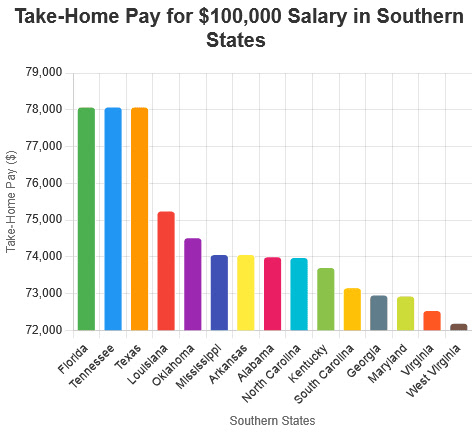
- The No-Tax Nine: States like Florida, Texas, Nevada, and Washington have $0 state income tax. In these states, your take-home pay is around $78,736.
- The High-Tax States: States like Oregon or California take another big bite. In Oregon, your take-home pay drops to about $70,540.
The Real Value: Factoring in the Cost of Living
Take-home pay is just the start. You still have to pay for a roof over your head and food on the table. We use a Cost of Living Index (COLI) where 100 is the national average.
- If a state has a COLI of 90, things are 10% cheaper than average. Your money has more purchasing power.
- If a state has a COLI of 150, things are 50% more expensive. Your money shrinks.