Revolutionizing Trade Finance: The Power of AI and Blockchain Innovations in 2025
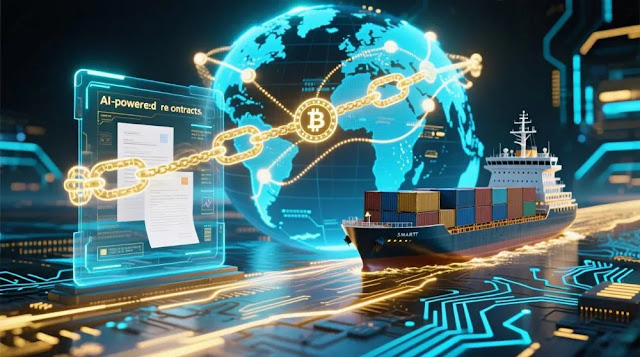
- Research suggests AI and blockchain could reduce
trade finance processing times by up to 80%, making global transactions
faster and more accessible for SMEs. - Evidence leans toward these technologies
enhancing transparency and fraud prevention, potentially preventing
billions in losses from issues like duplicate financing. - It seems likely that their integration will
promote sustainability and inclusivity, though challenges like
regulatory uncertainty remain, requiring balanced adoption strategies.
Introduction
Imagine a world where international trade deals close in minutes rather than weeks, fraud is virtually eliminated, and small businesses in developing regions access funding as easily as multinational corporations. This isn’t a distant dream—it’s the reality being shaped by AI and blockchain in trade finance today. Rising international trade is spurring innovation in these technologies. The focus remains on addressing longstanding challenges, such as excessive paperwork and limited access to financing.
Key Innovations in AI for Trade Finance
AI is streamlining routine tasks, handling everything from document verification to risk assessment. For instance, tools using optical character recognition (OCR) extract data from unstructured paperwork, slashing errors and time.
These solutions aim to close the $2.5 trillion trade finance gap that hampers small and medium-sized enterprises (SMEs).
Blockchain’s Role in Enhancing Security
Blockchain provides an immutable ledger for transactions, reducing fraud through smart contracts that automate payments upon condition fulfillment. Platforms like Contour verify documents tamper-proof, fostering trust in cross-border deals.
Synergies and Future Outlook
Combining AI with blockchain enables predictive analytics on secure ledgers, revolutionizing supply chain finance. While promising, adoption requires navigating technical complexities.
For more on AI applications, check our AI in Finance guide. Supporting insights come from a World Economic Forum report. Trade finance underpins international trade, facilitating the movement of goods and services across borders through financing, risk management, and payment solutions. In 2025, with international trade valued at trillions of dollars annually, innovations driven by artificial intelligence (AI) and blockchain are not just enhancements—they’re essential transformations. This comprehensive exploration delves into how these technologies are reshaping trade finance, drawing on recent developments, statistics, case studies, and practical insights. We’ll examine their individual contributions, synergistic effects, challenges, and future prospects, supported by authoritative sources and real-world examples.
Understanding Trade Finance and Its Challenges
Trade finance encompasses instruments like letters of credit (LCs), invoices, and supply chain financing that ensure smooth transactions between exporters and importers. Traditionally, it’s plagued by inefficiencies: paper-based processes, fraud risks, and a staggering $2.5 trillion funding gap as of 2022, disproportionately affecting small and medium-sized enterprises (SMEs), which face 45% rejection rates in financing applications.
Up to 80% of global trade relies on some form of financing, yet manual documentation leads to delays, errors, and high costs.
Enter AI and blockchain: AI enhances data analysis and process automatio.n Their integration tackles these challenges directly, paving the way for a more efficient, sustainable, and inclusive ecosystem. According to market projections, the AI in the trade finance sector is set to grow at an 18.6% CAGR, reaching $26.91 billion by 2029.
Blockchain applications in supply chain finance had a market value of $1.8 billion in 2024, with growth forecasted at 39.4% CAGR until 2034.
The Transformative Role of Blockchain in Trade Finance
Blockchain, a decentralized ledger technology, is revolutionizing trade finance by eliminating intermediaries and enabling real-time, tamper-proof transactions. In 2025, its adoption is accelerating, with public blockchains accounting for 62% of global transaction volume.
Key Innovations with Blockchain
- Smart Contracts for Automation:
These self-executing contracts trigger actions like payments when
predefined conditions are met, reducing LC processing from weeks to
minutes. Platforms such as TradeIX’s Marco Polo Network combine AI with smart contracts to automate processes in letters of credit and invoicing.
Fraud Prevention Mechanisms:
By creating immutable records, blockchain prevents issues like
duplicate financing. The 2014 Qingdao Metals Fraud, which cost $3
billion, could have been averted with such technology, as it flags
discrepancies in real-time.
Blockchain tracks goods from origin to destination, integrating with the Internet of Things (IoT) for real-time data. This is particularly useful
in supply chain finance (SCF), where platforms like Suchin provide
visibility, reducing disputes and enabling faster funding.
Benefits and Practical Tips
Blockchain reduces costs by eliminating paperwork and middleman fees, potentially saving billions annually. For businesses, start by partnering with platforms like Contour for document verification or Xin Fin for payments. A practical tip: Conduct a pilot project on SCF to test transparency gains before full-scale implementation.
Real-world example: A South American coffee exporter using Xinfeng received payments in seconds, bypassing traditional bank delays and boosting cash flow. In the wider financial sector, the blockchain market is expected to hit $22.46. For deeper insights into blockchain basics, visit our Blockchain in Supply Chain article.
AI’s Disruptive Impact on Trade Finance
AI is injecting intelligence into trade finance, automating complex tasks and providing predictive insights. By 2025, 77% of global employees are expected to use AI tools daily, with significant implications for finance.
Core Applications of AI
- Automation of Document Processing:
Using OCR and natural language processing (NLP), AI extracts data from
unstructured documents, achieving 80% reductions in processing time.
- This includes three-way matching of purchase orders, invoices, and receipts.
- Risk Assessment and Fraud Detection:
AI models Analyse vast datasets for credit scoring and anomaly
detection, lowering loss rates. For SMEs, this democratizes access to
finance. - Predictive Analytics for Market Trends: AI forecasts demand and risks, aiding in better decision-making.
- Compliance and ESG Integration:
AI automates checks for anti-money laundering (AML) and environmental,
social, and governance (ESG) factors, promoting sustainable trade.
Case Studies and Stats
AI-powered processes at Twinco Capital streamline shipment documentation, increasing accuracy and efficiency.
In West Africa, Jetstream’s AI tools have facilitated over $8 million
in loans to SMEs, with loss rates half the industry average, cutting
credit decision times from a month to under a minute. A notable example
involving John Deere illustrates broader supply chain integration. While
primarily known for precision agriculture, John Deere has explored
blockchain for transparent grain and livestock markets, combined with AI
for data-driven financing in ag trade. In 2025, amid layoffs to fund AI
innovations, Deere’s stock reflects resilience, with an 18.8% operating
margin outperforming peers, highlighting how tech investments bolster
financial stability in trade-related sectors.
Practical tip: Implement AI-powered platforms like those from SureComp for fraud detection—start small with pilot integrations to measure ROI.
Explore our Fintech Innovations hub for related reads.
Synergies: AI and Blockchain Fusion in Trade Finance
The true power emerges when AI meets blockchain. AI enhances blockchain’s smart contracts with predictive capabilities, while blockchain provides secure data for AI training.
Integrated Innovations
- AI-Powered Smart Contracts: Platforms like Xin Fin combine AI for dynamic pricing and blockchain for secure execution.
- Decentralized Finance (DeFi) in Trade: This enables peer-to-peer lending, with DeFi borrowing up 30% in Q1 2025.
Inclusivity and Sustainability:
AI-blockchain sandboxes, like those from the World Economic Forum,
focus on equitable processes, reducing carbon footprints through
digitization’s study: Equity Mark Investments uses AI-blockchain for trading, improving security and efficiency.
In trade finance, this fusion could automate end-to-end processes, from LC issuance to settlement.
Challenges in Adoption
Despite benefits, hurdles include regulatory uncertainty, technical complexity, scalability issues, and data governance.
For instance, the “digital island problem” arises from fragmented initiatives, requiring cross-jurisdictional alignment.
Practical tips: Address these by advocating for standardised frameworks and investing in training. Businesses should assess ROI using metrics like processing time reductions (target 80%) and cost savings (up to 50% in fraud prevention).
Future Outlook and Emerging Trends
Looking ahead, 2025 trends include AI-driven autonomous transactions and blockchain-enabled CBDCs for seamless trade.
Initiatives like the Trade Tech Global Sandbox emphasize AI-blockchain for efficiency and equity.
Table: Key Statistics on AI and Blockchain in Trade Finance (2025 Projections)
|
|||||||||||||||||||||||
|---|---|---|---|---|---|---|---|---|---|---|---|---|---|---|---|---|---|---|---|---|---|---|---|
Another table: Top Platforms for AI-Blockchain Integration
| Platform | Key Feature | Use Case |
|---|---|---|
| Marco Polo Network | AI-Integrated Smart Contracts | LC Automation |
| Contour | Fraud Prevention Ledger | Document Verification |
| Xin Fin XDC | Instant Cross-Border Payments | Global Settlements |
| Jetstream | AI Credit Scoring | SME Financing |
| Twinco Capital | Document Digitization | Efficiency Gains |
Conclusion
AI and blockchain are not merely tools; they’re catalysts for a more resilient trade finance landscape in 2025, enhancing efficiency, security, and accessibility. By automating processes, preventing fraud, and fostering inclusivity, they address critical gaps and drive growth. However, success hinges on overcoming regulatory and technical barriers through collaboration.
Ready to innovate your trade finance strategies? Subscribe to our newsletter for the latest fintech updates or contact us for personalized consultations. Let’s build a future-proof trade ecosystem together.
Key Citations:
- World Economic Forum Report on AI in TradeTech
- How Blockchain Is Revolutionizing Trade Finance in 2025
- AI in Trade Finance Market 2025
- Blockchain in the Supply Chain Finance Market
- AI and Blockchain Fusion in Finance
- Blockchain Statistics 2025
- Blockchain in Financial Services Statistics
- John Deere Blockchain in Ag Markets
- John Deere 2025 Layoffs and AI
- Addressing Challenges in Blockchain Adoption
- Trade Finance on the Blockchain 2025 Update
- Blockchain Statistics & Facts 2025
- Digital Payments and AI Integration