Choke Point Pressure: Tanker Hits in the Strait of Hormuz and the Threat to World Fuel Routes
Petrol pump prices feel ordinary until a sudden spike hits on Monday morning. We expect tankers to glide quietly across open water without a hitch. Out in the Gulf right now, that calm passage is breaking down fast.
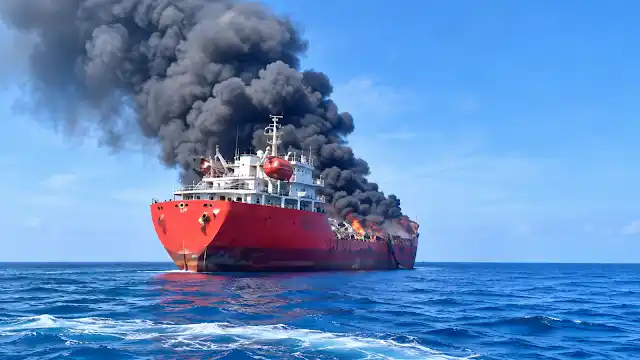
Looking straight at the Strait of Hormuz tanker crisis, recent missile hits and sudden ship diversions show how fragile this oil route really is. Once a narrow sea lane turns into a shooting gallery, global trade stumbles within hours.
Mystery Strikes and Emergency Rescue Runs
The maritime alarm bells started ringing hard over the weekend. Official security warnings from the United Kingdom Maritime Trade Operations (UKMTO) confirmed two separate projectile hits on commercial vessels inside the Strait of Hormuz within forty-eight hours.
UKMTO logs marked Incident 166-26 on 11 October, where an outbound tanker reported an unknown hit while clearing the passage. Just a day later, on 12 October, Incident 168-26 warned that a product carrier took another direct projectile impact along an outbound route. UKMTO confirmed the crews were unharmed, but they urged captains in the area to sail on high alert.
Emergency crews in Oman faced fresh drama forty-four miles off South Al Batinah. Engine flames on the cargo ship JOHN K forced an Omani military helicopter to scramble fast, airlifting an injured sailor to hospital. For cargo crews hauling heavy crude, sailing past these waters now feels like a bad gamble.
Supertankers Turn Around as Freight Costs Jump
The reaction from international energy markets came without delay. Reporting from Bloomberg confirmed that supertankers have begun swinging away from key Gulf transfer hubs near Fujairah.
Tanker captains simply hate parking multi-million-pound crude loads near hot zones. As ships swerve onto longer routes, cover rates and daily tanker rents have shot through the roof. Oil desks know that holding back even a small slice of Gulf crude triggers instant market panic.
UK Airbase Alert and Fresh Western Sanctions
The conflict did not stay confined to coastal waters. Over in southern England, a security scare at RAF Fairford—a key base used by the United States Air Force—set off alarms across Western capitals. Reporting by CBS News noted that the British government joined partners across the US, Australia, Canada, France, and Germany to warn Tehran against hostile foreign actions.
The UK Foreign Office reacted by putting sanctions on two Iranian men, claiming they helped back overseas threat plots. Envoys from Tehran fired back at Anadolu Agency, calling the British claims pure fiction and asking for an open probe. It just proves how fast sea-lane scuffles turn into international security rows.
Hormuz as an Economic Lever and the Cable Threat
Inside Tehran, state rhetoric has become remarkably direct. General Abolfazl Shekarchi, speaking through Al Mayadeen, challenged Western security promises by arguing that Washington struggles to shield its own bases, making regional guarantees ring hollow.
More importantly, reporting from Al Jazeera highlighted remarks from Mohsen Rezaei, senior advisor to the Supreme National Security Council, stating clearly that the Strait of Hormuz remains a core bargaining chip. Iranian officials made it plain that transit rules will stay exceptionally tight until foreign oil sanctions and financial blocks get lifted.
To make matters more unpredictable, regional reports in JFEED revealed growing calls from Revolutionary Guard media demanding transit and sovereignty fees on commercial undersea internet cables lying on the Gulf seabed. Targeting digital infrastructure alongside oil tankers marks a completely new front in modern geopolitical pressure.
At the end of the day, hoping the world’s busiest oil gateway will fix itself while trade sanctions and military exchanges rage on is pure wishful thinking. Until both sides sit down to sort out their messy feud, common sailors and high-street drivers will keep paying the price.
Frequently Asked Questions
What recent incidents did UKMTO report in the Strait of Hormuz?
UKMTO released warnings 166-26 and 168-26 covering two separate projectile hits on outbound commercial tankers on 11 and 12 October.
Why are supertankers diverting away from Gulf hubs?
According to Bloomberg, crude supertankers shifted routes away from Fujairah and the Strait of Hormuz due to rising projectile risks and steep marine insurance rates.
Why did Britain introduce sanctions against Iranian nationals?
CBS News reported that the UK issued sanctions against two Iranian figures following a security alert at RAF Fairford airbase in southern England.